How to read this page
Everything here inherits the program's own label discipline. Every quantitative claim carries a stamp; treat unstamped numbers as context. There is exactly one MEASURED stamp on this page.
MEASURED a bench result exists · MODELED physics model, no Quantom data yet · ESTIMATE cost/market band pending quotes · TARGET stated goal a partner may counter · DECIDED locked inventor decision · OPEN undecided, owner named.
Sources: the frozen program package v2 (Docs 0–19, audited 2026-07-06), the 7 July execution set (vendor shortlist, use-of-funds, readiness index), line-item procurement research run tonight (six research threads, prices labeled), and a five-model frontier consult (§8). Prepared by CC Sam for Austin, Mike, and Murat.
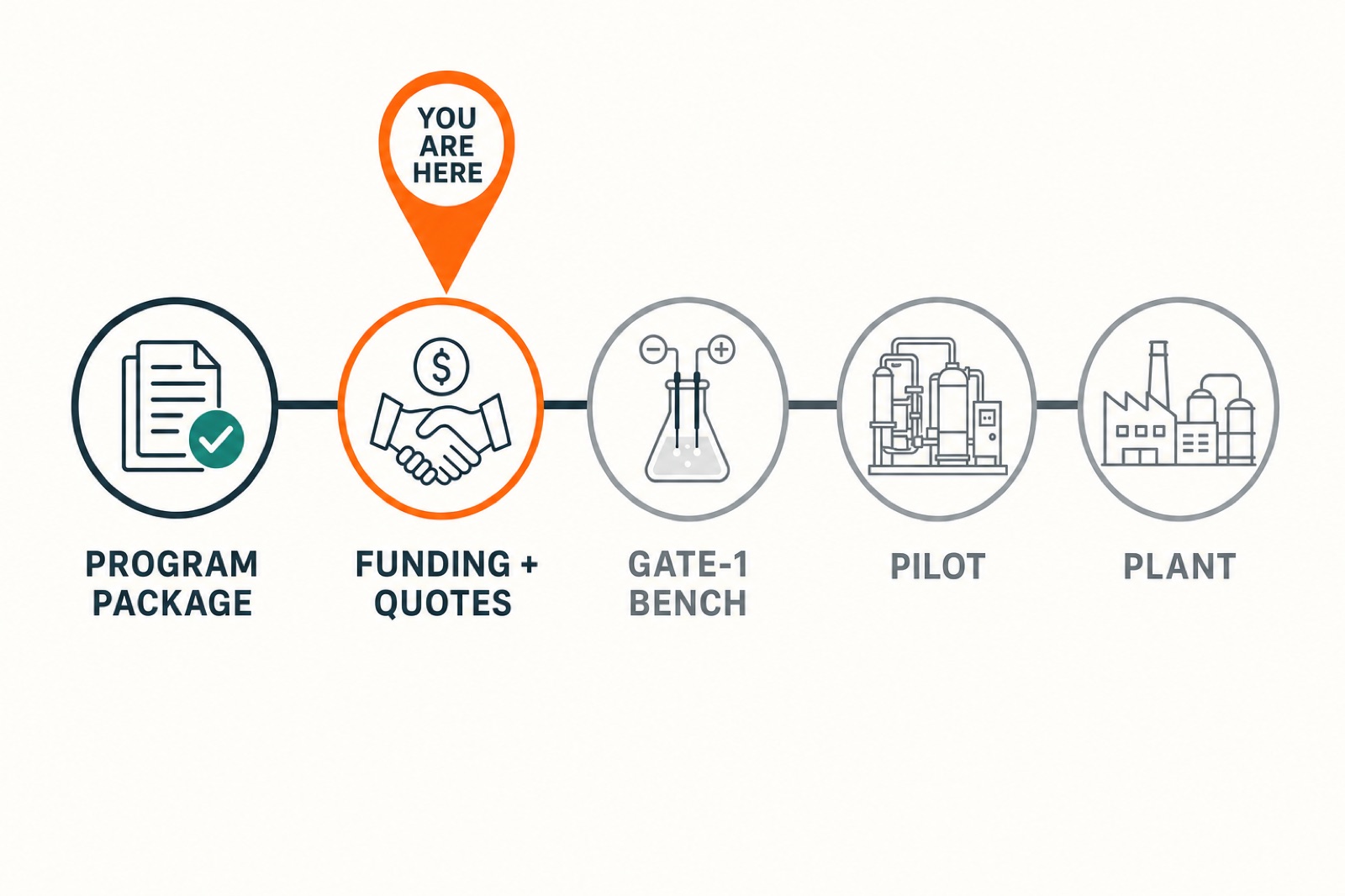
The paper is finished. The build is staged, not started.
The program spent June and early July converting a filed provisional and a physics record into a complete, internally-consistent engineering program — then pre-positioned every external dependency to the last step that doesn't cost money. The day capital lands, a purchase order goes out, not a scramble.
Done
- 24-document program package frozen + 4-layer audited, zero open failures (Doc 17).
- IP spine: QUAN-1004-PRO filed 7 May 2026; parent QUAN-1001 US + PCT filed 2 Apr 2026; Rule 132 provenance declaration on record; vault register (V1–V5) established before the data exist.
- FE electron ledger — the canonical 70% planning number now has channel-by-channel physics provenance MODELED.
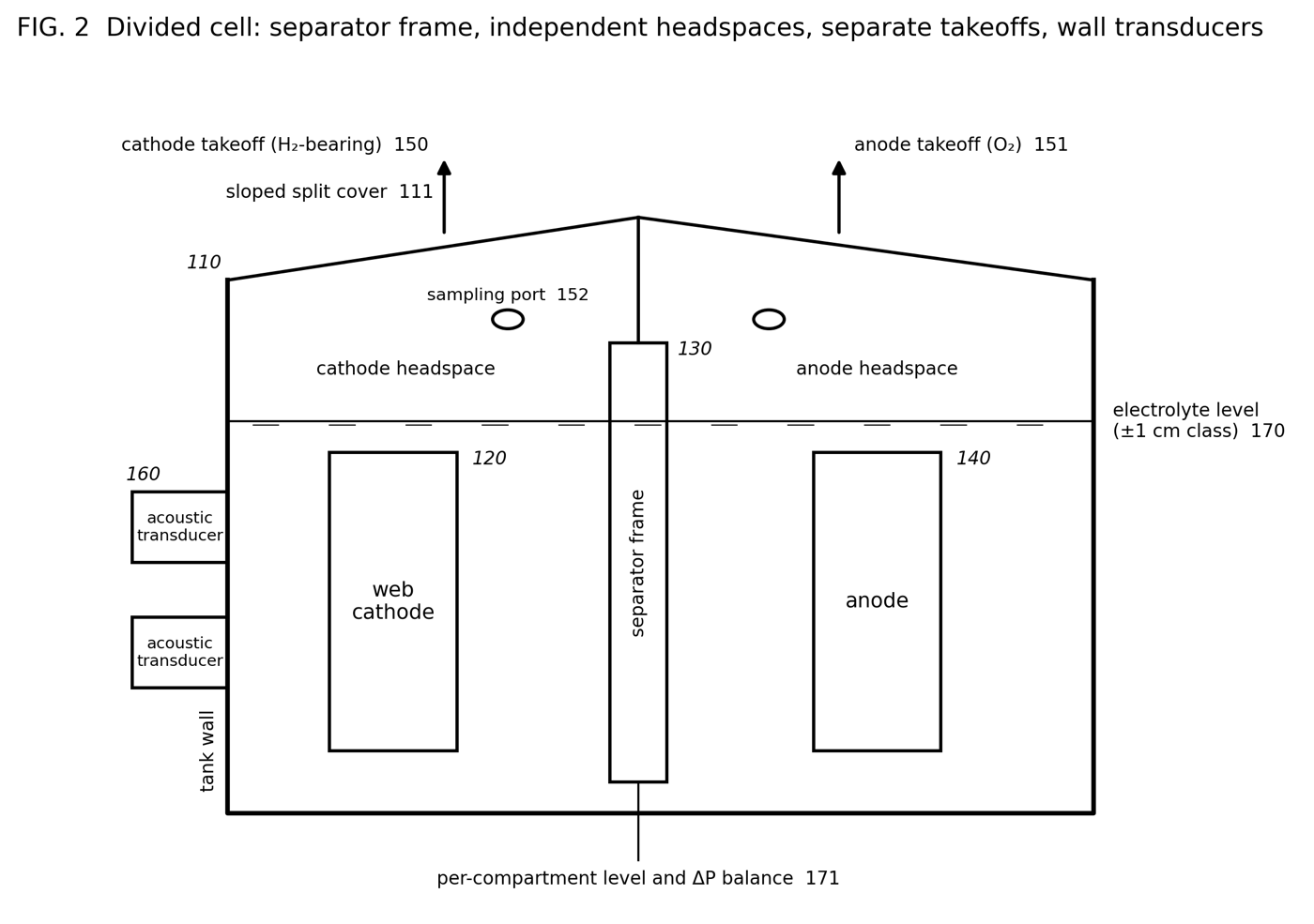
- Safety case — shared-headspace H₂/O₂ shown flammable-to-detonable at any practical utilization; divided cell locked as mandatory DECIDED.
- RFQ out 7 July to Zeton, NESI/NORAM, ElectroCell, EPIC, Electrosynthesis; interest replies targeted ~17 July.
- Metrohm NDA executed, package sent (instrument vendor lane).
- Data-room readiness index — 15 external dependencies, each with owner, status, and gate.
Not started (deliberately)
- No hardware ordered. PO issues at T-zero (first funds).
- No lab site committed. DTU / DTI / Nottingham candidates; none has confirmed on-site CO₂; program stays DK-homed DECIDED.
- FE unmeasured — the entire economic case rides on the Gate-1 bench answer OPEN · bench.
- Engineering partner unselected — RFQ replies pending OPEN · ~17 Jul.
- Carbon-credit methodology doesn't exist for electrochemical CO₂→solid carbon; new workstream with Puro/Isometric OPEN.
- Follow-on provisional decision before external disclosures widen OPEN · counsel.
The one measured fact MEASURED
The Nottingham chip-scale provenance result: CO₂ became solid carbon preferentially at the seed. Locked to a provenance-only role — no FE or rate baselines transfer from it. Everything else in the program is a model with a plan to become a measurement.
A strip-plating line that grows carbon
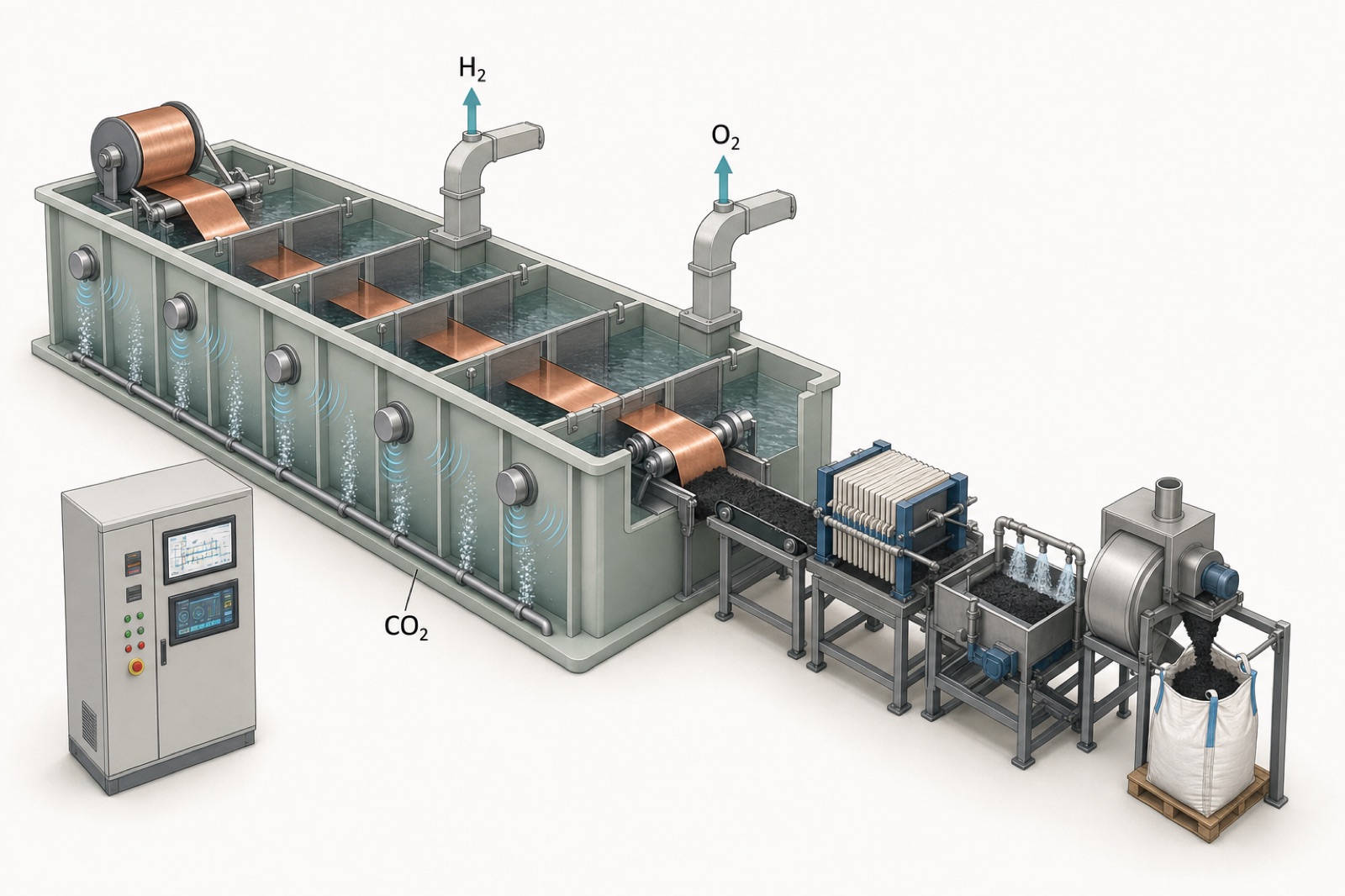
The architecture is deliberately un-exotic: a polymer open tank the shape of a continuous strip-plating line, with a roll-to-roll copper web as the cathode. CO₂ sparges in from the base; carbon grows on the seeded web; an acoustic field controls the process and releases the product; the wet carbon is washed to a conductivity endpoint, dried, and finished to bagged, industry-standard forms. Four additions carry all of the program's engineering: compartment separators, an external heat-rejection loop, a seed application station, and segregated gas trains.
Divided cell
Separator frames between electrode rows give each compartment its own headspace and takeoff. This one decision buys hydrogen purity (resale-grade), the safety envelope (no H₂/O₂ mixture anywhere in normal operation), and protects FE from oxygen crossover — worth up to ~40 FE points under acoustics MODELED.
Seeded web
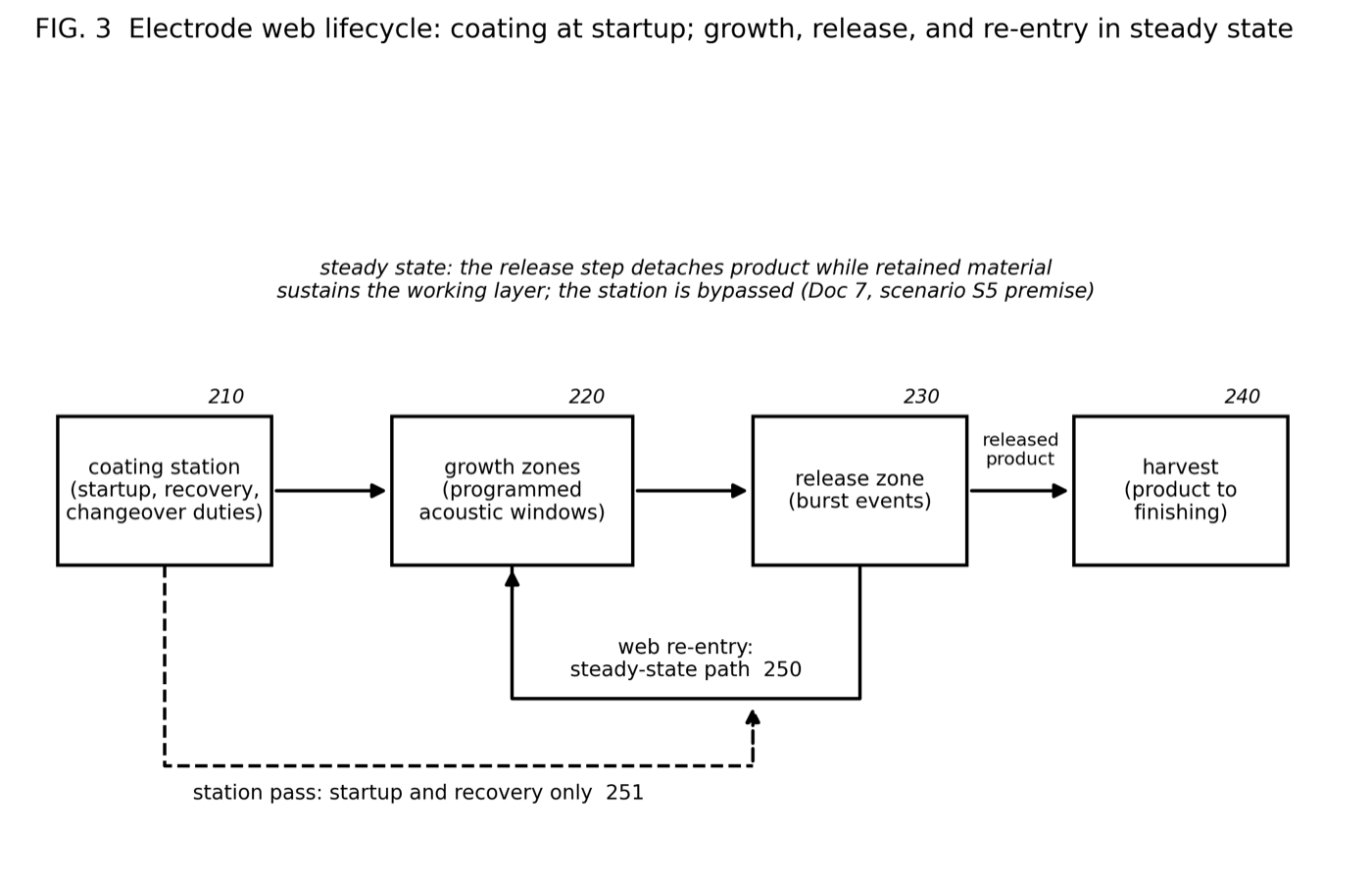
Seeding is a startup and maintenance duty, not a running consumable DECIDED: release detaches product from the layer, never strips to metal; the cascade regenerates nucleation sites. The A1 generational series is the proof.
Acoustic systems
Release transducers (20–40 kHz) at the harvest zone; growth arrays (50–500 kHz) along the run for morphology control. Schedules are vault trade secrets — vendors supply components, never the process.
Gas trains
Cathode: condense → dry → CO₂ strip (recycled to sparge) → compress → purify to 99.5% H₂. Anode: demist → vent (or sale). Composition closes the vents, not procedure.
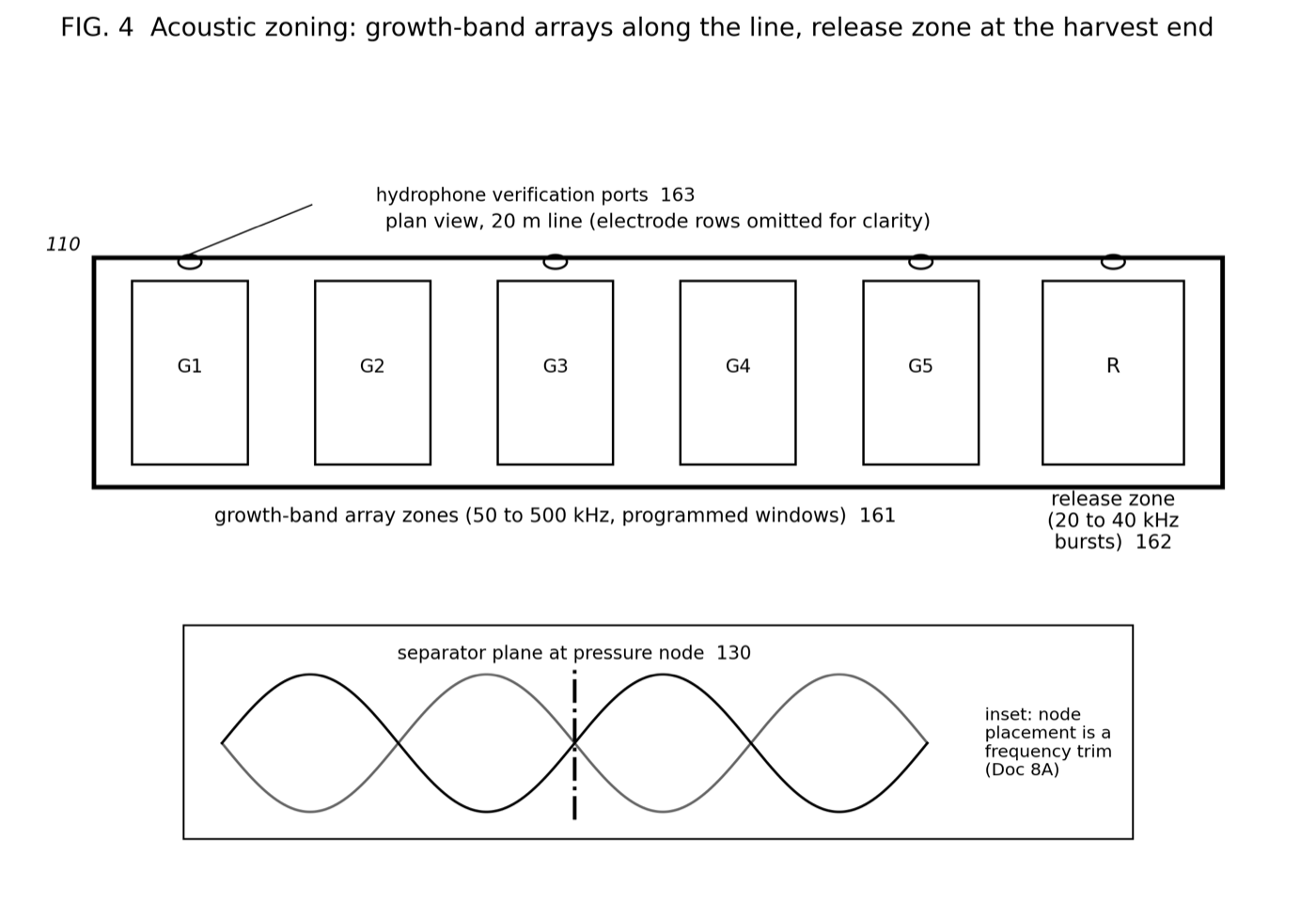
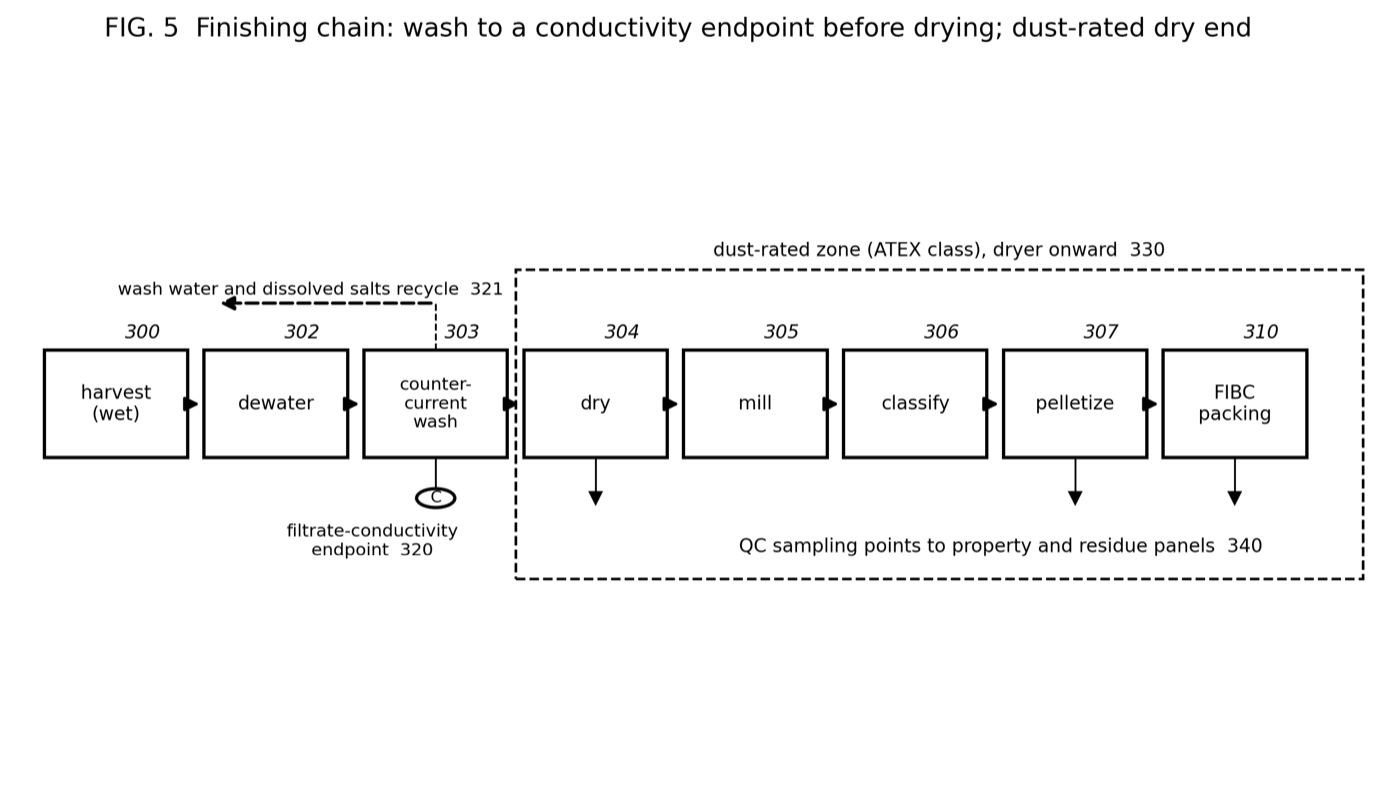
Product thesis (“the Inversion”): this mechanism's natural output is fine, high-surface-area carbon — the industry's hardest, most expensive grade (N110-equivalent class) is our path of least resistance. Entry lanes are specialty ($2.5–6/kg) and conductive ($6–15/kg) ESTIMATE, not commodity rubber blacks.
Faradaic efficiency is the whole ballgame
FE — the fraction of electrons that end up in solid carbon — sets the slope of every cost line in the company. It reduces to one measurable ratio: growth current density against a parasite floor. The floor is engineerable to ~0.8 mA/cm² in a separated, sparged, encapsulated cell; the growth current is the single dominant unknown, and it is directly measurable on a $50–155K bench.
The canonical FE table, drawn
What FE and power price do to the dominant cost line
Cash cost ex-capital stacks to $2.1–2.9/kg at 3¢ power and $3.1–4.1/kg at 6¢ MODELED+ESTIMATE. At FE 70, specialty and conductive grades clear their price bands under every modeled power scenario; commodity is a cheap-power-siting question, not a physics question. Hydrogen capture hedges FE risk on bulk grades: with the cathode stream sold at green pricing, site revenue is nearly flat across the whole FE band MODELED.
Why FE could disappoint, per the ledger: oxygen crossover in an undivided/leaky configuration (the separator is the fix), exposed metal substrate multiplying hydrogen evolution (encapsulation requirement), and the growth current simply landing low — which is exactly what M1 measures first.
Cheap decisive measurements first, everything expensive behind them
The spend philosophy in one sentence: nothing expensive is purchased ahead of the measurement that justifies it. The first $50–155K answers FE and the seed delta; the pilot's long-lead orders wait for that readout; the Mode-2 acoustic array waits for the morphology map.
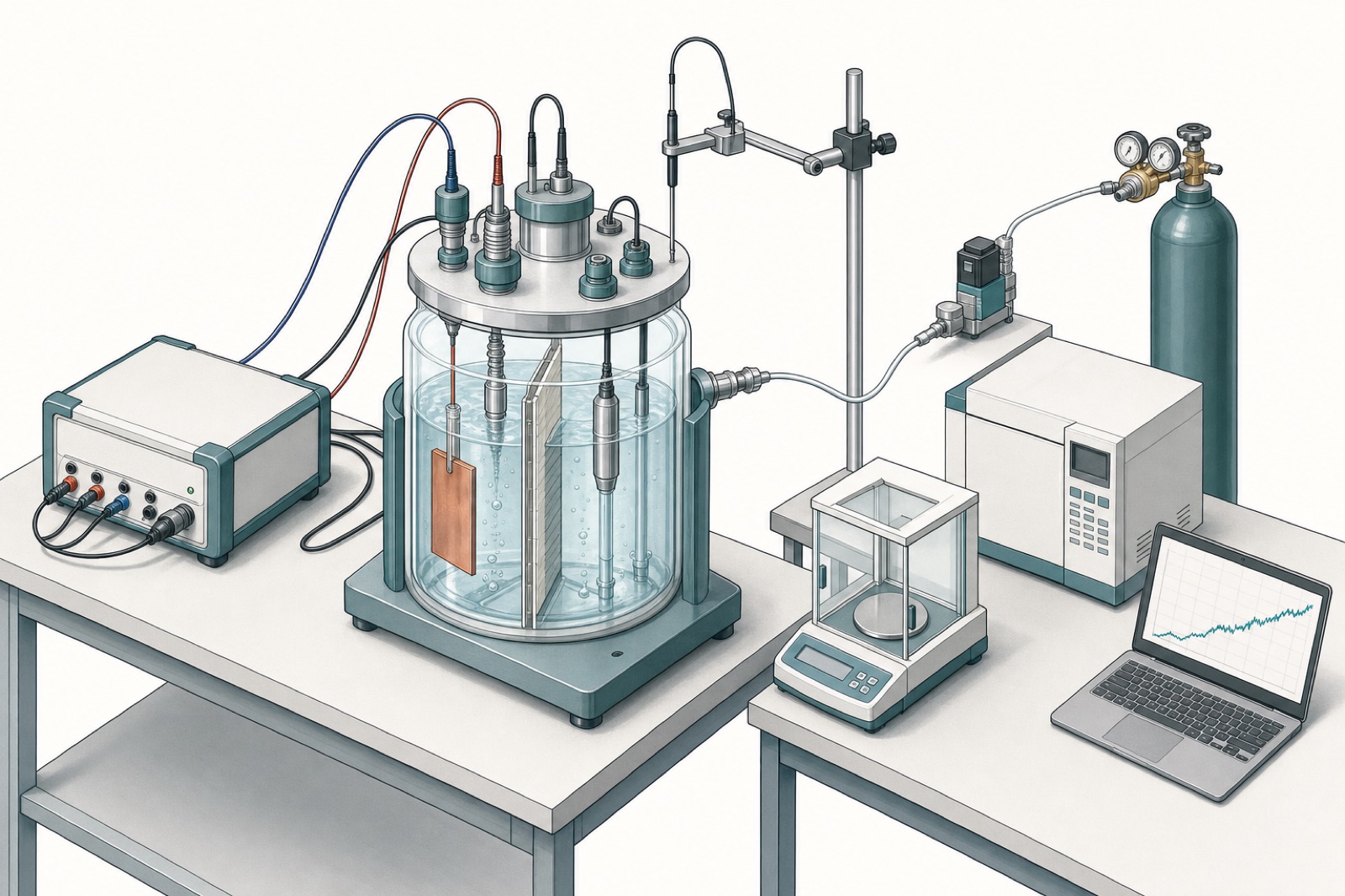
M1 — mass-versus-charge with H₂ volumetry
Pass: electron balance closes ±10% on washed-dry mass; canonical FE table updates MODELED → MEASURED at n=3.
Fallback: FE persistently <40% → economics reroute to cheap-power siting; program continues re-scoped.
A1 — unseeded floor vs seeded delta
Pass: seeded FE exceeds the floor by the modeled margin at matched conditions.
The only halting gate. Stop-and-diagnose — and the least likely failure: its chip-scale version is the one measured fact in the record.
M3 — divided vs undivided cartridge + crossover + field maps
Pass: FE delta resolved; diaphragm-vs-membrane media memo issued from data before pilot procurement.
Fallback: small delta → separator stays anyway (purity + safety); media chosen on crossover and cost.
M4 — acoustic schedule grid vs morphology + temperature rider
Pass: monotonic, reproducible coupling across the grid → Mode-2 array order releases; the map goes straight to the vault.
Fallback: flat map → commodity-plus-hydrogen plant proceeds; premium thesis parked with the data recorded.
WP5 — commissioning protocol
Pass: every safety interlock tripped for real; field maps in window; plant-scale A1; wash endpoint proof; first bagged lot with complete genealogy.
Fallback: punch-list loop inside WP5 — no partial acceptance.
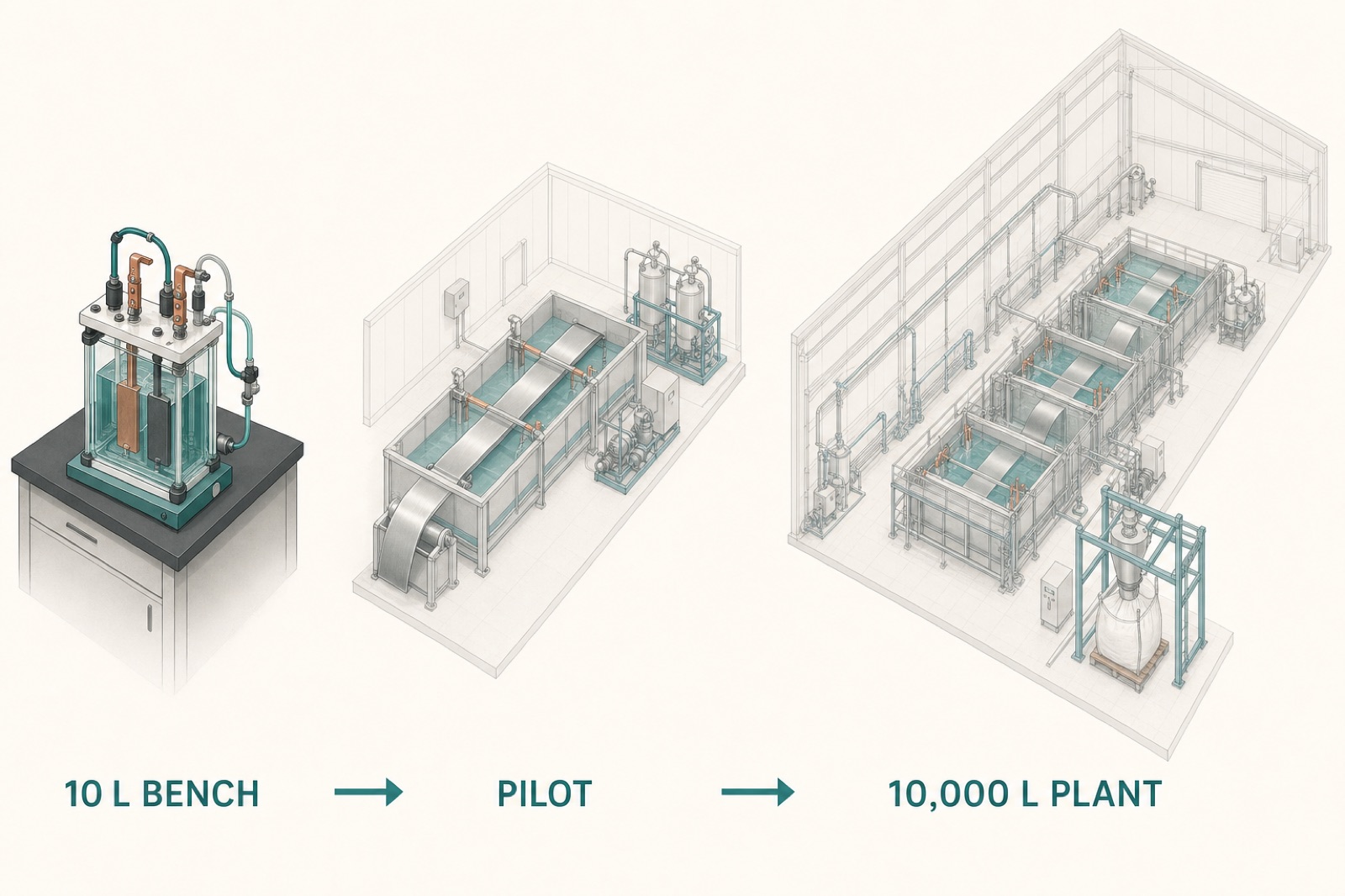
T-zero is first funds. The schedule runs through procurement, not physics.
Work packages from T-zero
| Milestone | Offset from funds | Calendar (Q3-26 close) |
|---|---|---|
| Purchase order issues (pre-positioned) | T+0 | on close |
| Gate-1 rig commissioned | T+6–10 wk | late Q3 / early Q4 2026 |
| FE measured — the proof point | T+10–14 wk | ~Q4 2026 |
| Bench full exit (M4 map + ¹³CO₂ provenance package) | T+18–26 wk | Q1 2027 |
| Pilot commissioned, first bagged lot | ~2 quarters after bench order | Q1–Q2 2027 |
| First carbon-black sales (Bridge model) | — | Q2–Q3 2027 MODELED |
| Internal conversion go-decision — bench anchors (M1/M2/A1 + provenance) must be in hand to build a measured-support conversion payload | — | early March 2027 (plan/LEGAL-IP-BRIEF.md) |
| Patent conversion deadline (hard) | — | 7 May 2027 |
The runway clock
On the $500K base raise alone, cash lasts ~5 quarters (to ~Q3 2027) — the Q4-2026 proof point has roughly three quarters to convert into seed, grants, or CORC pre-funding. The $1M target stretches runway to ~Q2 2028 and is the number that de-risks the bridge MODELED.
Three budgets, one discipline
Bench $156–514K fully built, of which only $50–155K (Gate-1) is needed to answer FE and the seed delta. Pilot €575K–1.43M with the full upgrade set (central €0.8–1.0M). The 10,000 L plant stays a parameterized cost model, not a budget ESTIMATE · all bands pending quotes.
| Spend step | Amount | Waits on |
|---|---|---|
| 1 · Gate-1 bench subset — runs M1, M2, M3, A1 | $50–155K | nothing but lead times — day-one money |
| 2 · Bench completion — Raman group, acoustic arrays, M4 | balance of $156–514K | informed by step-1 results |
| 3 · Pilot long-leads — tank, rectifiers, cooler, coater | first pilot tranche | M1/A1 readout (the cheap-decisive rule) |
| 4 · Separator media at area scale | inside €30–90K | M3 media decision |
| 5 · Pilot build + commissioning | balance of €0.8–1.0M central | long-leads on site |
| 6 · Mode-2 acoustic array | €41–108K | M4 coupling shown |
Pre-seed use of funds ($500K base)
| Line | Buys | Amount |
|---|---|---|
| Reactor build | 10 L validation bench — the proof machine (Gate-1 first) | $165K |
| Validation / characterization / lab | Grade QC, impurity panel, potentiostat + electroanalytical instruments, consumables | $198K |
| Core IP | CB + Metal/Alloy + Ghosthand provisionals, counsel; conversion 7 May 2027 | $40K |
| Founders (phase-gated, below market) | $5K/mo each at $250K raised, $10K at $500K | $72K |
| Ops + reserve | Entity, compute, contingency | $15K |
~75% of the base goes to the prototype and the lab work that proves it. The $1M target is the same plan plus runway: five quarters → eight.
Tonight's research check on the Gate-1 band
Line-item pricing (§7) says the honest Gate-1 number sits in the upper half of the $50–155K band once three under-banded realities are counted: a boostered flagship potentiostat runs $27–48K vendor-dependent against the $15–40K line (only the Metrohm NDA path sits cleanly in-band); a Type-I water system ($10–17K, not in the subset list) is mandatory for CO₂RR-grade electrolyte; and fixed gas monitoring realistically lands $7–9K. A lean-real Gate-1 build prices at ≈$110–160K ESTIMATE — inside the band, but plan against its top, not its floor. The full-bench chiller ($20–26K) and filter press ($14K) can defer past Gate-1 if the jacket circulator covers M1-scale heat.
The shopping list, priced against the real market
Six research threads priced the Gate-1 and bench line items against July-2026 vendor reality. Confidence labels: PUBLISHED live list price · ESTIMATE grounded band, confirm at RFQ. Long-lead traps are flagged — they, not physics, set the schedule.
Order on day one (long-lead traps)
| Item | Why first | Realistic lead |
|---|---|---|
| Potentiostat + booster | Build-to-order across all four vendors; the bench schedule-setter | 8–14 wk LEAD |
| Custom 10 L cell (jacketed, ported) | Custom glass fabrication | 8–16 wk LEAD |
| ¹³CO₂ (99 atom %) | Isotope gases backorder unpredictably; confirm live stock, quote CIL + ISOTEC, buy whichever ships | 2–12+ wk LEAD |
| Zirfon separator sheet | No US catalog SKU — Agfa sample request + reseller import in parallel | 2–6 wk LEAD |
| ≥2 kW chiller (full bench, deferrable past Gate-1) | Build-to-order class | 6–14 wk LEAD |
| Filter press (full bench, deferrable) | Build-to-order; Büchner/Nutsche route covers Gate-1 | 6–12+ wk LEAD |
| Ritter MGC-1 gas counter | German-built; check RITTER USA stock, else Alicat MFM fallback ships in days | 4–10 wk LEAD |
Electrochemical core
| Item | Pick | Budgetary | Backup | Note |
|---|---|---|---|---|
| Potentiostat + booster 1–10 nA RMS · µs pulse · true zero-current hold · EIS · 7.5 A | Metrohm Autolab PGSTAT302N + FRA32M + BOOSTER10A — NDA fast path, only firm published pricing (302N+FRA32M $24,150 list), 20 V compliance, in-band; caveat to close in the quote: BOOSTER10A (~4 kHz full-power BW) cannot pulse µs at 7.5 A — fine if the high-current drive is ms-class; price VIONIC alongside or pivot if not | $27–37K PUB+EST | Bio-Logic SP-300 + HCV-3048 — the only in-budget config delivering <3 µs pulses at the full 7.5 A, plus the field's best compliance (48 V), ~$30–42K; PARSTAT MC/4000A credible alternate. Gamry 3020+30k now ~$43–57K — over ceiling, used-market only | The decision question that picks the vendor: are µs pulses needed AT 7.5 A, or only at low current? The booster's large-signal bandwidth, not the base unit, sets that limit — get a noise plot + booster rise time in writing |
| 10 L jacketed cell, ported | Chemglass / Ace custom body + custom GL-port lid + Julabo Corio CD-200F circulator | $13–17K EST | Across International Ai 10L ($5,490 PUB) + separate custom lid — confirm port support in writing | Borosilicate, not 316L — the transparent body is the optical access |
| Divided-cell cartridge | Ossila H-type cell with peel-apart membrane rings ($750 PUB, ships ~1 day) for method shakedown; custom PTFE cartridge for the 10 L vessel via Xometry/uni shop | $0.75–1.5K | Protolabs PEEK (~2–3× PTFE) | The program's $0.5–3K band is right |
| Separator media | Zirfon PERL UTP 500 sheet (Agfa sample request + reseller ~$776/50×50 cm EST) and Fumasep FKB-PK-130 ($32/sheet PUB) | $0.4–0.9K | Nafion 117 (~$0.20/cm² PUB) | Buy both classes — M3 decides; porous vs ion-selective are not interchangeable |
| Electrodes | Goodfellow 4N OFHC Cu foil (from $187 PUB) + MMO Ir/Ru-on-Ti anode (redox.me ~$54/plate PUB) | $0.5–1.0K | Pt gauze 25×25 mm (~$400–550) only where a protocol demands it | MMO avoids Pt-dissolution poisoning of the Cu cathode — better science and ~20× cheaper |
| Reference electrode | BASi MF-2052 (3 M NaCl fill) + MF-2030 double-junction chamber ≈ $206 PUB | $0.2K | redox.me refillable + junction adapter (~$477) | Most catalog “double-junction” units are sealed KCl — they fail the spec; don't order the MF-2056 sibling |
| Electrolyte + water | ELGA PURELAB flex 3 ($9.9–10.4K PUB) + Thermo Puratronic Na₂CO₃/NaHCO₃ + full cleanup train (Chelex, pre-electrolysis, acid-washed glassware) | $10.7–18.9K + $5–9K/yr | Milli-Q IQ 7000 ($16.7K PUB) | Grade alone is insufficient — ppb Fe/Ni plate onto the cathode and eat FE; the cleanup train is not optional |
Gas, thermal, safety, finishing
| Item | Pick | Budgetary | Note |
|---|---|---|---|
| CO₂ delivery skid | Alicat MC-1SCCM-D MFC ($2,245 PUB) + two-stage CGA-320 regulator + fine-frit sparger + research 4.8 CO₂ | $3.7–4.5K | Size the cylinder down — a size-200 at bench flow is a 4-year supply |
| ¹³CO₂ provenance path | Sigma/ISOTEC 364592, 10 L, 99 atom % ($4,391 PUB) + Swagelok 3-way + per-leg check valves | $4.6–7K | One 10 L bottle ≈ a full campaign (~166 h at 1 sccm); check valves so ¹²CO₂ can't back-mix into the expensive bottle |
| Inert purge | UHP Ar 5.0 + Entegris/SAES MicroTorr point-of-use purifier | $1.3–2.5K | Regulator/line ingress dominates — POU trap is mandatory regardless of gas grade |
| H₂ volumetry | Ritter MGC-1 MilliGascounter (composition-independent, mL/h-class) | $2–3.5K LEAD | Backup: Alicat MFM with genuine H₂ calibration ($1.1K, ships days) + $27 eudiometer cross-check |
| Fixed safety monitors | RKI Beacon 410A + 3 heads (CO₂-NDIR, H₂ 0–100% LEL, O₂) wired to fan + E-stop | $7–9K | Relays are the interlock actuator — composition closes the vent, matching the program's safety philosophy |
| Chiller (full bench) | Lauda Variocool VC 3000 — 3.0 kW, ±0.05 °C | $22–26K LEAD | Named Huber Ministat / Julabo DYNEO classes are <0.5–1 kW — undersized for the 2 kW acoustic load; jacket circulator covers Gate-1 |
| Wash / filtration / dry | VACUUBRAND ME 1C + Büchner/Nutsche route + Mettler FiveEasy F30 conductivity kit ($1,450 PUB) + Across AT19-UL vacuum oven ($2,690 PUB) | $7–9K lean | ErtelAlsop 4D plate-and-frame press ($13,740 PUB) joins at bench-full; standard (non-Ex) oven is fine for water-washed carbon |
Acoustic subsystem (components only — schedules stay vault)
| Item | Pick | Budgetary | Note |
|---|---|---|---|
| Release/cavitation transducers 20–40 kHz | 2–4× immersible plate/rod packs (Weber SONOSUB class; US alternates Crest / Blackstone-NEY / Branson) + matched generators | $8–25K EST | Distributed field matches the release duty; commodity market, low vendor risk; buy on kHz/W spec only |
| Growth array 50–500 kHz | Custom: APC/Steminc piezo elements + used E&I 1040L amps (10 kHz–5 MHz, covers the 2 MHz stretch) + Zurich HDAWG-4 phase-coherent source | $10–65K by zone count EST | Amplifiers dominate cost; used E&I market halves them. HDAWG doubles as the schedule engine — the schedule stays in our software, portable across drive hardware |
| Hydrophone + mounts | Calibrated needle hydrophone + preamp + 3-axis positioning; Thorlabs breadboard + kinematic mounts + passive isolation | $6–12K EST | Field maps are a NON-NEGOTIABLE acceptance instrument (25% amplitude window), not a nice-to-have |
| Single-vendor watch | Broadband linear RF amps are a thin field (E&I, AR, T&C) — qualify two; everything else in the subsystem has healthy substitution | ||
Metrology (the swing item lives here)
| Item | Pick | Budgetary | Note |
|---|---|---|---|
| Confocal Raman microspectrometer 532 nm primary, mapping stage — program band $40–120K | Edinburgh RM5 (tightest true-confocal budget fit, ~$70–110K) or Bruker Senterra II (~$90–160K; carbon-materials pedigree, auto-calibration for multi-month D/G tracking) | $70–160K EST | The band is honest but tight: flagship 2-laser configs (Horiba Soleil/Odyssey, Renishaw Qontor, WITec) run $120–300K. In-situ immersion leg: InPhotonics RamanProbe II ($6,745 PUB) on a compact host later — spec 785 nm on it for water background. One vendor (Ostec) dropped on an export-control flag |
| Hydrophone field mapping 20 kHz–2 MHz + positioning | Two hydrophones, not one: RESON TC4013 (to ~170 kHz) + Precision Acoustics 2 mm needle system (~100 kHz–>2 MHz) on a Velmex BiSlide 3-axis rig | $13–19K new · $8.5–13K w/ used reference leg EST | No single unit spans the band. Watch: the PA submersible preamp is rated 0–50 °C vs the 60 °C bath ceiling — keep the preamp head above waterline or confirm an exception |
| Balance + gas GC + volumetry | Sartorius Entris II BCE224-1S ($3,220 PUB) + SRI 8610C Multi-Gas #5 (TCD, MolSieve 5A + HayeSep — H₂/O₂/CO/CO₂ in one method) | ~$23K total | Micro-GCs (Agilent 990) are the “right class” but 2–3× the band; SRI keeps the $8–25K line intact. %-level H₂ is fine on He carrier; add an Ar-carrier channel only if ppm H₂ matters later |
| Synchronized DAQ (one clock) | NI cDAQ-9178 + 9205/9213/9223/9402 modules, Python nidaqmx | ~$9.4K PUB | Sync is a wiring problem, not a sample-rate problem: potentiostat analog monitor into AI, acoustic drive into the fast module, TTL timestamp per Raman spectrum |
| Process sensors | pH / conductivity / DO on one Mettler M800 (ISM) or Hamilton Arc digital-direct | $11.5–13K EST | Dissolved-CO₂ probes pin near full-scale in a CO₂-saturated catholyte — qualitative trend/interlock only; the GC + MFC pair is the quantitative CO₂ balance |
Seed application (bench) + where to build
| Item | Pick | Budgetary | Note |
|---|---|---|---|
| Bench coater (S1/S2 trials) | Ossila Slot Die Coater ($10,500 PUB) or MTI MSK-AFA class (battery-electrode pedigree, ~$6–16K); RK K303S Multicoater (~$18–35K) if true gravure is required | $6–35K | Bar coating (Ossila $5,250 PUB / MSE PRO $6,941 PUB w/ integrated dryer) is the proven cheap primary for carbon slurries; gravure cells clog on abrasive carbon at the thin end |
| In-line loading sensor | Machine-vision reflectance/contrast station (industrial USB3 camera + coaxial LED + OpenCV) anchored by gravimetric coupons | <$5K | Physics check that saves money: carbon black goes optically opaque at a few tenths mg/cm², true coat-weight gauges are 6-figure, and XRF is blind to carbon — expect ~0.1 mg/cm² absolute below the opacity knee, coupons above it |
| Drying line | Coater's own heated bed + EXAIR air knife ($282–750 PUB) + MTI DZF-6020 vacuum oven ($1,998 PUB) | <$6K | Off-the-shelf IR conveyors are 150–320 °C screen-print dryers — de-rate and thermocouple-verify to hold the 25–80 °C window |
| Bench venue — US bridge | Greentown Labs (Somerville) — climatetech-only, CO₂-utilization thesis fit, shared potentiostat already in the wet lab | ~$3.9K/bench/mo PUB | The Engine (Cambridge) is the #2 with piped CO₂. The binding constraint everywhere is H₂ venting, not CO₂: stay under the 1,000-scf flammable-gas MAQ per control area, EH&S sign-off → fire permit → verify |
| Bench venue — DK/NL home | DTU Science Park / Futurebox lease (cleanest IP: a lease creates no IP claim) with GreenLab Skive as the scale-up target (on-site CO₂ from biogas); Brightlands Chemelot is the only option with H₂ already piped to labs | venue-dependent | IP hygiene rule: prefer a lease you run or fee-for-service with written foreground-IP assignment — never a co-funded collaboration (publication rights + shared IP). DTI's default = client owns foreground; DTU-the-university's default = university owns |
Engineering-partner lane (pilot)
| Firm | Role fit | Status 7 Jul |
|---|---|---|
| Zeton (NL/CA) | Pilot-line prime / integrated wet skid — strongest overall; subs the electrochemical core | RFQ sent; route via info@zeton.nl naming Jan-Hein Willemsen |
| NESI / NORAM (CA) | Electrochemical reactor core + scale-up inside a real EPC — can span core and skid | RFQ sent; CEO Jeremy Moulson is the entry, CTO Clive Brereton technical CC; fix legal name on the NDA |
| ElectroCell (DK) | EU cell hardware; aligns with the Danish venue track | Replied — cell supplier only, out to week 32 → NDA next |
| EPIC Systems (US) | US skid alternative to Zeton; no electrochemistry in-house | RFQ sent; re-confirm contacts against VINCI/Actemium routing |
| Electrosynthesis Co. (US) | Bench-scale electrochemistry CRO — derisking lane, not a plant builder | RFQ sent; David Genders entry, Pete Symons technical |
| Metrohm | Measurement instruments (a tool, never an enabling system) | NDA executed, package sent — the live fast lane |
| Finishing tier | Hosokawa (NL, primary), Eirich (DE), Tema/Therma (NL); Mars Mineral for pelletizing | Letters drafted, awaiting review/send; Hosokawa+Mars are not independent quotes |
| Deliberately absent | No sonochemistry process partner, ever — the acoustic assembly is client-supplied to any integrator DECIDED | |
Five frontier models reviewed this plan tonight
The identical 11,200-character brief went to five frontier models tonight — GPT-5.5 Pro, Grok Heavy, Grok Expert, Claude Opus 4.8 Max, and Gemini Deep Think — each asked for its strongest critique of Gate-1 execution, procurement, build-vs-buy, vendors, technical risk, siting, and completeness. The convergence was unusually strong.
Forced panel verdict
Fundable to Gate-1, not yet build-ready — and the fix is measurement discipline, not more hardware. The staging instinct (cheap decisive measurements before capital) survives contact. What doesn't: running "does the chemistry work?" and "commission a custom acoustic reactor" as one gate. The panel's prescription — split Gate-0 metrology / Gate-1 FE×jC / Gate-2 seed delta, run it hybrid at an electrochemistry CRO with our acoustic module black-boxed, speciate every product from run 1, and put the ¹³CO₂ provenance run inside Gate-1 — turns the first $150K into a defensible number instead of an expensive opinion.
Where the five agree (and who caught what)
| Claim / recommendation | GPT | Grok-H | Grok-E | Opus | Gemini |
|---|---|---|---|---|---|
| Hybrid CRO build; acoustic module stays a client-supplied black box | ● | ● | ● | ● | … |
| Measurement chain is the #1 schedule killer, not the cell | ● | ● | ● | ● | … |
| Gate-0 metrology shakedown on a known reaction before any CO₂ claim | ● | — | ◐ | ● | … |
| Carbon FE must not be by-difference; dual closure + C₁–C₃/alcohol speciation | ◐ | — | — | ● | … |
| Pre-electrolysis electrolyte purification is mandatory | ● | ● | ● | ● | … |
| Reference drift under pulse+acoustics corrupts the window; double-junction + spares | ● | ● | ● | ● | … |
| Pulse-waveform fidelity at current must be scope-verified (booster bandwidth trap) | ● | — | — | ● | … |
| ¹³C provenance moves INTO Gate-1, microscaled | ● | — | — | ● | … |
| Defer the Raman buy; outsource/lease for Gate-1 | ● | ● | ● | ● | … |
| Gas-analytics line under-scoped ~2× (GC = method development + cal gas) | ● | ● | ● | ● | … |
| Zirfon–cavitation coupling: fatigue, blinding, fines, DP monitoring, spares | ● | ● | ● | ● | … |
| Gate-1 site needs existing H₂ compliance (CRO / hosted lab), never a bare wet-lab | ● | ● | ● | ● | … |
| Pilot siting: Rotterdam/Brightlands pragmatically beat DK-first; DK stays HQ | ● | ● | ● | ◐ | … |
| Pilot long-leads gate on G2, not WP1 exit | ● | — | — | ● | … |
| EU vendor gaps: C-Tech, De Nora, TNO/Fraunhofer, media makers, ATEX body | ● | ● | ● | ● | … |
| First measured FE likely 35–55%; survivable if the seed delta is loud | ◐ | ◐ | ● | ● | … |
| FE-vs-current-density curve as a first-class deliverable | ● | — | — | ● | … |
| Potentiostat band low for boostered flagship; ~$45K+ realistic | ● | ● | — | ● | … |
● raised/endorsed · ◐ partial or implied · — not addressed · … still generating at publish time. Full texts in the accordions below; nothing was averaged away.
Gemini Deep Think was still generating when this page was built; its column fills in the archive copy and the matrix cells marked “…” update on capture.
The five catches that change the plan most
1 · Gate-0 before Gate-1 (GPT, Opus)
Prove ±5% coulombic closure on a KNOWN reaction (water electrolysis / ferricyanide) with the exact gas train, seals, logger, and pulse hardware — before anyone reports a carbon FE. A FOAK bench that skips this ships a confident number that can't be defended.
2 · No by-difference carbon (Opus)
M2 misses CH₄/C₂H₄ and alcohols — the classic aqueous CO₂RR products. Carbon FE must close two independent ways: gravimetric on the washed deposit AND full product accounting on the same coulombs. Disagreement = a mystery, not an FE.
3 · Provenance inside Gate-1 (Opus, GPT)
A microscale ¹³CO₂ spike + third-party IRMS with chain of custody, early. The program's own history says provenance is the diligence wall — a beautiful FE 70 without it stays un-diligence-able.
4 · The diaphragm IS the safety case (all four)
Cavitation pits and perforates Zirfon-class media; a perforated diaphragm recreates the mixed headspace the whole architecture exists to prevent. Torture-test it under the real field early; interlock on cross-gas sensing; stock spares.
5 · WBS sequencing bug (Opus, GPT)
Pilot long-leads currently release at "WP1 exit," which can mean a single FE number. Gate WP3 on G2 — seed delta, separator delta, and closure boringly repeatable — before pilot capital moves.
Real divergences, preserved
- How hard is the G1 bar? Grok Expert: lower the go/no-go to FE>40% with a loud (≥15-pt) seed delta — momentum matters for a FOAK first. GPT: FE and partial current density must be reported as a pair, with ≥5 mA/cm² for pilot relevance. Opus: keep 70 as the target, stage closure ±15%→±10%. Resolution adopted: GPT's decision-table form, where closure quality × jC × seed delta route the outcome — no single-number pass/fail.
- M1 closure tightness: both Groks want ±5%; Opus argues ±10% is already aggressive for wet-harvested carbon. Adopted: ±5% at Gate-0 on the known reaction (cheap there), staged tolerance on carbon.
- Bench host: Grok Heavy puts DTU hosted-lab first (ATEX solved, DK optics); GPT/Opus put the CRO first (speed + an independent, diligence-credible number). Unanimous disqualifier: anywhere without existing H₂ compliance.
- ElectroCell: push harder / dual-source (Grok-H) vs verify their filter-press geometry fits an open-tank web concept at all (Opus).
Flagged annex (out of protocol, one catch kept)
A parallel Gemini conversation — fed a truncated brief fragment and drawing on the account's memory of earlier Quantom sessions — returned a review mixing tonight's brief with prior-session knowledge; its "fraudulent model" headline overreaches and is not counted in the panel. One catch survives on its merits: the Bridge model's carbon-black revenue ramp is priced at ~$2,000/t tire-grade while the program's own unit economics put cash cost at $2.1–2.9/kg — internally acknowledged (specialty-first strategy, figures labeled modelled illustrations), but the Bridge revenue line should be re-anchored to the specialty band before investor use, and the CORC leg should carry the no-methodology-exists flag more loudly.
Full reviews (verbatim, with provenance)
GPT-5.5 Pro — full review (chatgpt.com · Pro Extended · 11m37s of thinking)
Show more
I’ll treat this as a red-team build-readiness review: verify time-sensitive vendor, facility, standards, and equipment realities, then focus on Gate-1 defensibility, FE failure modes, procurement schedule killers, and concrete buy/test/no-go moves.
Early synthesis: Gate-1 should become a narrower truth cell, not a 10 L miniature factory. The schedule killers are metrology, pulsed-power integration, gas-tight wet hardware, and audit-grade electron accounting.
Thought for 11m 37s
(1) Executive verdict, 10 lines
This is a credible hard-tech program, but not yet build-ready for pilot. It is Gate-1-ready only after the metrology spine is hardened.
The plan overweights reactor construction and underweights the ugly little gremlins: gas closure, reference stability, electrolyte provenance, separator state, and sample accounting.
FE alone is the wrong Gate-1 king. The gate should be FE × carbon partial current density × closure × repeatability × seeded delta.
The 10 L acoustic rig should not be the critical-path article for the first truth test. Use a smaller sealed analytical cell in parallel, with acoustics coupled as an experimental variable.
The “parasite floor” model is too tidy. In the real cell, HER, O2 reduction, exposed substrate, and separator fouling will not behave like a fixed constant.
The highest-probability schedule killer is not the cell. It is the gas train plus analytics plus leak-tight wet electrochemistry behaving badly enough to make every FE number arguable.
The second killer is custom hardware: separator cassette seals, acoustic feedthroughs, web fixturing, reference placement, and wet carbon handling.
The third killer is facility permission: H2, CO2 cylinders, ultrasonics, isotope gas, and fine carbon are exactly the kind of “small experiment” that triggers large EHS eyebrows.
My recommendation is hybrid build: CRO-hosted electrochemical metrology core, Quantom-owned acoustic/seed module, and a parallel internal DK bench only after the first credible FE/seed result.
Do not order pilot long-leads after a single FE number. Order pilot long-leads only after seed delta, separator delta, and gas/mass closure are boringly repeatable.
ASK 1: Gate-1 execution critique
My biggest change: split Gate-1 into three sub-gates. Right now Gate-1 is trying to answer “does the chemistry work?” while simultaneously commissioning a custom reactor. That is how a clean question gets dragged into a swamp wearing ankle weights.
Gate-0: metrology acceptance before any CO2-carbon claim.
Run the exact gas train, flow meters, seals, data logger, pulse hardware, and separator cartridge on a known electrochemical gas-producing baseline. Do not let anyone report carbon FE until the system proves charge-to-gas closure. Acceptance should be: [likely] 95-105% charge-to-H2/O2 closure on a known water-electrolysis control; [likely] leak rate less than 1% of expected H2 generation over the run duration; [likely] reference drift less than 5 mV/hour and less than 10 mV pre/post against a second reference; [likely] all flow, pressure, temperature, and current data captured with synchronized timestamps.
Gate-1: carbon FE plus partial current density.
A 70% FE at a toy partial current is not a pilot basis. You need to report carbon FE and carbon partial current density, always as a pair. I would define the first credible pass as: [likely] n ≥ 3 seeded runs, same protocol, same geometry; carbon mass-charge closure within ±10% maximum, with ±5% target; ash-corrected carbon identity by CHN/TGA/ICP or equivalent; H2 measured independently; CO/formate/dissolved carbon measured or bounded. Also require at least one pilot-relevance run with [verify] carbon partial current density ≥5 mA/cm² for 2-4 hours. Stretch target: ≥10-20 mA/cm² with FE ≥50%. If FE is high only at very low jC, that is scientifically interesting but not build-ready.
Gate-2: seed delta.
This is the only halt gate in your plan, and I agree. I would sharpen it: [likely] seeded FE must exceed unseeded FE by at least 20 FE points or at least 2×, whichever is more conservative, under identical charge, geometry, electrolyte, gas flow, and pulse history. Also require a seed carryover control: seed-coated coupon soaked, acoustically treated, and washed without current to quantify non-electrochemical seed loss masquerading as product.
Your existing “FE <40 means economics reroute to cheap power” is too soft. Cheap power does not rescue a mechanism where the parasitic reaction scales with surface area, acoustic stripping, or separator fouling. My rule would be:
Result Decision
Good closure, seeded delta absent Halt chemistry program, not just economics
Good FE, low jC Continue bench science, no pilot long-leads
Good jC, FE 35-50, clean seeded delta Continue, but redesign around power/siting and loss mitigation
Bad closure No technical conclusion; fix metrology
Separator/gas crossover unstable No pilot design; separator architecture unresolved
The three highest-probability schedule killers inside 10-14 weeks:
1. Gas analytics and wet gas handling.
H2, CO2, O2, water vapor, and CO at low levels are an annoying orchestra. CO2 dissolves, gas bags leak H2, water traps bias composition, MFC calibration is gas-specific, and small leaks look like low FE. The plan prices “GC/volumetry” as though it were a box. It is really a method-development package. If the GC or micro-GC arrives late, lacks the correct columns, or needs method tuning, your first month of data becomes decorative fog. SRI’s multiple-gas analyzer configuration is explicitly aimed at H2/O2/N2/CO/CO2 mixtures, but the basic TCD detection is only in the hundreds of ppm range, while lower CO/CO2 detection requires methanizer/FID or HID options. [known]
Acme Revival
2. The custom divided acoustic cell.
Separator gaskets, diaphragm compression, hydrophone ports, reference positioning, gas headspace geometry, and acoustic feedthroughs will not behave on the first build. Plan for three spare separator cassettes, three web cartridges, and a “dead-simple sealed coupon cell” that can run while the 10 L article is leaking like a philosophical argument.
3. Reference electrode and potential-control credibility.
Ag/AgCl in low-chloride bicarbonate with bubbles, current pulses, ultrasonics, and local pH gradients is a drift trap. Use two references: one working Luggin-style near the cathode and one independent check reference. Log pre/post potential against a stable check electrode. Use current interrupt or EIS/HFR for iR. Never report only “applied voltage vs Ag/AgCl” without showing reference health.
Specific additions to Gate-1:
Add a no-carbon control ladder: no CO2, no seed, no current, no acoustics, and seed-with-acoustics-no-current. This catches seed shedding, organic contamination, carbonate/oxide precipitation, and wet filtration artifacts.
Add ash correction and elemental accounting from day one. Every “carbon mass” should have wet mass, dry mass, ash/TGA, ICP metals, CHN carbon, and filtrate TOC/IC. Carbon black standard characterization later should include surface area and oil absorption. ASTM D6556 is the standard method for total/external carbon black surface area by nitrogen adsorption, and ASTM D2414 covers oil absorption number. [known]
ASTM Store
+1
Move the 13CO2 provenance run earlier, but microscale it. Do not wait until the full cell is beautiful. A tiny isotope run that proves deposited carbon derives from CO2 will save weeks of theological debate. Cambridge Isotope lists 10 L of 99% 13CO2 at $2,500 with low stock as of the current product page, so treat isotope gas as a day-one procurement item if it matters to first-quarter credibility. [known, verify exact quote/import]
Isotope
ASK 2: Procurement reality check
The current Gate-1 budget bands are optimistic in exactly the wrong places. The big underpriced categories are gas analytics, high-current pulsing, safety/interlocks, custom cell spares, and calibration. The over-scoped category is Raman ownership. Buy data, not a shrine.
Items likely to break the 10-14 week plan
Item Risk My action
High-current potentiostat/booster [likely] 6-16 weeks new, depending configuration and stock RFQ day one; ask for delivery date in writing; have backup programmable DC supply plus potential monitoring
GC/micro-GC [likely] 8-20 weeks for new configured system Either use CRO/institutional GC immediately or buy SRI/used system as stopgap
MFCs, regulators, certified calibration gases [likely] 2-8 weeks, more with specialty mixes/country fittings Order day one; include water traps, back-pressure control, flashback/check valves
Custom divided acoustic cell [likely] 4-10 weeks if properly machined and leak-tested Build smaller analytical cell first; 10 L cell parallel path
Hydrophone with calibration [likely] 6-12 weeks for calibrated low-frequency/MHz coverage Order day one; rent/borrow if possible
Raman microscope [likely] 8-24 weeks new Do not buy for Gate-1; outsource
Lab roll-to-roll/coating hardware [likely] 8-20 weeks Not Gate-1 critical; use hand/doctor-blade/spray seeded coupons
13CO2 [known] specialty gas, low-stock page seen; [verify] delivery/import Order enough for a microscale isotope proof, not a vanity run
Preferred instrument classes
For potentiostat/pulsing:
Metrohm Autolab PGSTAT302N with Booster20A is a sane choice because Metrohm is already engaged; the Booster20A raises the PGSTAT302N to 20 A with 20 V compliance. [known]
Metrohm
Gamry Reference 3020 plus 30k booster is attractive if pulsing and high-current EIS matter; Gamry specifies ±30 A and 300 kHz EIS bandwidth for the booster. [known]
Gamry Instruments
+1
BioLogic VSP-300 is strong if you want modularity and parallel boosters; BioLogic states up to 10 A booster boards, parallelable to 40 A, with high-frequency EIS support. [known]
BioLogic
My recommendation: Gamry or Metrohm for Gate-1, not both. Metrohm if relationship/support dominates. Gamry if high-current pulsing fidelity dominates. For anything above 30-40 A, stop pretending a research potentiostat is the main power plant. Use a proper programmable DC supply, isolated measurement, and a pulse module designed for the waveform, with the potentiostat used as a sensing/control instrument.
For GC/micro-GC:
Best clean option: Agilent 990 Micro GC or INFICON Micro GC Fusion class. Budget option: SRI 8610C Multiple Gas Analyzer, but specify the exact detector package. Basic TCD may be enough for H2/O2/CO2 bulk closure; trace CO needs methanizer/FID or HID. [known]
Acme Revival
For chiller:
Use Julabo FL/FLW or Huber Unichiller class, not a hobby chiller. Huber’s Unichiller line includes models up to 10 kW, and the Unichiller 030T datasheet shows 3 kW cooling capacity across common setpoints. [known]
Huber
+1
For a 10 L acoustic cell, [likely] 1 kW is not enough once you add electrochemical heat, acoustic inefficiency, warm lab air, and safety margin.
For hydrophone/acoustic metrology:
Precision Acoustics 2 mm needle hydrophone is suitable for the low-MHz process-control band; its published minimum calibration frequency is 30 kHz and the 2 mm model is specified for 100 kHz to 10 MHz use. [known]
Precision Acoustics
+1
Onda is a good calibration house; they state calibration capability from 0.03 kHz to 60 MHz conforming with IEC 62127. [known]
Onda Corporation
Add a passive cavitation detector if you care about cavitation onset, not just acoustic pressure.
For coating/seeding:
For Gate-1, do not buy a roll-to-roll coater. Use a reproducible coupon process: doctor blade, spray, dip, or screen fixture. For full bench, Coatema, FOM Technologies, and MTI are reasonable. MTI’s lab roll-to-roll product pages are RFQ/“email for lead time,” which is procurement-code for “do not put this on a 10-week critical path without a written ship date.” [known]
MTI Online Store
Coatema explicitly offers lab and roll-to-roll systems for lab-to-pilot coating. [known]
Coatema
For Raman:
Outsource first. If buying later, Thermo DXR3 is the practical “materials lab” choice; Renishaw inVia or WITec/Oxford Instruments are stronger for high-end mapping. Thermo lists DXR3 for material science/nanomaterials applications, and a public reseller page shows a DXR3 microscope price around $74,850, but final configured pricing must be quoted. [known, verify]
Thermo Fisher Scientific
+1
Renishaw’s inVia is a research-grade confocal Raman system. [known]
Renishaw
Budget bands I would correct
Potentiostat + booster, $15-40K: [likely low]
New high-current, EIS-capable, pulsing-capable systems are more plausibly $45-120K depending vendor, booster, software, and service. Used or CRO-owned can fit your band.
Cell + cartridge, $5-15K: [likely low for your actual cell]
For a simple coupon divided cell, yes. For 10 L, gas-tight, divided, acoustic, hydrophone ports, removable separator cassette, H2-safe venting, and spares: [likely] $25-75K.
Gas minimal, $5-15K: [low]
Realistic Gate-1 gas train with MFCs, regulators, certified calibration gases, traps, pressure relief, gas sensors, tubing, check valves, and leak-test kit: [likely] $20-60K.
Balance/volumetry/GC, $8-25K: [low unless CRO/used]
A new configured GC/micro-GC can consume most of the Gate-1 budget. Volumetry alone is not enough for credibility.
Safety, $3-10K: [low]
H2 sensors, CO2/O2 deficiency sensors, ventilation interlock, E-stop, relief routing, acoustic enclosure, shields, and signage: [likely] $15-50K, depending host facility.
Raman group, $40-120K: [too low for new high-end, okay for outsourced/used/entry]
Do not put ownership in Gate-1. Use external Raman/BET/PSD/ICP/PAH labs until product volume and morphology justify capital.
Day-one orders: potentiostat or power electronics, gas analytics path, MFC/regulator/calibration gas set, H2/CO2/O2 sensors, chiller, hydrophone/calibration, separator sheets/cassettes/gaskets, cartridge spares, reference electrodes, filtration hardware, analytical salts/water standards, isotope gas for microscale proof.
Staged orders: Raman, roll-to-roll coater, full acoustic array, pilot tank, finishing equipment, pelletization, classifier/mill, dust collection beyond bench minimum.
ASK 3: Build-vs-buy for the bench
Recommendation: hybrid, with CRO-hosted electrochemical metrology first.
Option (a), self-build in a rented lab, is seductive because it feels like control. I would not choose it for the first quarter. The hidden schedule cost is brutal: lab lease, EHS approval, cylinder permissions, ventilation, H2 detection, wastewater, GC setup, machine-shop iteration, and data-system debugging. A small team can absolutely self-build eventually, but self-building the first truth rig is how you spend $150K discovering Swagelok as a worldview.
Option (b), pure CRO, is too exposed. The seed/web/acoustic interface is the crown-jewel zone. A CRO will also optimize toward what is convenient in their lab, not necessarily your eventual architecture.
Option (c), hybrid, is the right answer.
Structure it like this:
Quantom supplies a sealed or semi-sealed client acoustic/seed module with an interface-control document. The CRO sees only the allowed electrical, thermal, mechanical, and acoustic envelope. They do not receive tuned acoustic schedules. They get black-box labels such as “Mode A/B/C” or preloaded waveform files if needed.
The CRO owns and commissions: gas-tight divided analytical cell, power instrumentation, gas analytics, MFCs, reference practice, electrolyte handling, and raw data capture.
Quantom owns: seed preparation, acoustic module, web geometry constraints, test matrix, IP-critical process labels, and final interpretation.
Quantom scientist physically witnesses the first runs. Raw data exports are copied daily into Quantom’s controlled archive. Sample IDs are blind-coded before external labs.
This gives speed and credibility without handing the integrator the spellbook.
ASK 4: Vendor and RFQ strategy
The current RFQ list is good but mis-sequenced. You have pilot builders in the room before you have a pilot basis. That is not fatal, but it invites glossy budgetary theater.
Zeton is a credible modular pilot-plant builder; they state more than 1,000 projects across 45 countries. [known]
Zeton Inc
NESI/NORAM is directly relevant for electrochemical process scale-up; NORAM says its electrochemical team moved to NESI and retains access to pilot plant and engineering/fabrication capabilities. [known]
NORAM Engineering
+1
ElectroCell is a logical cell-hardware contact; they offer lab, pilot, and production-scale electrochemical cells/systems. [known]
Electrocell
+1
Electrosynthesis is right for bench CRO work; they explicitly offer confidential electrochemical R&D, engineering, and lab/pilot facilities. [known]
Electrosynthesis
Who is missing in Europe:
C-Tech Innovation, UK. Add them. They have electrochemical engineering, electrolyte development, pilot-scale equipment, and commissioning language close to your need. [known]
MTEC
+1
De Nora, Italy/Germany. Not necessarily as a full build partner, but as an electrode/cell/process sanity-check partner. They are a major electrochemical-process company with electrodes, alkaline electrolysis, gas diffusion electrodes, and CO2-conversion-adjacent language in their portfolio. [known]
De Nora
+1
Permascand, Sweden. Add for electrodes, coatings, and electrochemical cell manufacturing perspective. They are not an EPC, but they understand electrochemical hardware and high-current realities. [known]
High Coast Invest
Pfaudler/Normag or De Dietrich class. Add for corrosion-resistant vessels, glass/PTFE-lined process hardware, and pilot skid discipline. This is not the core electrochemistry brain, but it is useful for tanks, wetted materials, and process integration. Pfaudler advertises pilot testing and scale-up capability. [known]
GMM Pfaudler
TNO/VITO/RISE/DTI/Fraunhofer/DECHEMA class. Not as primary integrators, but as validation or applied-research partners when you need a European credibility wrapper.
For finishing vendors, Hosokawa/Eirich/Tema is directionally right. Hosokawa has recovered-carbon-black milling/classification offerings, Eirich covers mixing/granulating/pelletizing, and Tema/Therma fluid-bed dryers advertise carbon black/recovered carbon black relevance and ATEX options. [known]
Hosokawa Alpine
+2
Eirich USA
+2
But do not send them a full finishing RFQ yet. Ask for sample-test requirements: minimum wet cake mass, dry solids needed, moisture limits, dust/Kst data needed, and toll-test slot timing.
RFQ sequencing
Do paid pilot pre-engineering in parallel, but do not let it become pilot procurement.
From the 7 July RFQ date, a realistic budgetary-quote timeline is:
[likely] 1-2 weeks: acknowledgment, NDA, “are we interested?”
[likely] 2-4 weeks: technical clarification, especially because Europe is heading into summer holiday gravity.
[likely] 4-8 weeks: rough budget quote from a modular skid/pilot firm if scope is clean.
[likely] 8-12 weeks: meaningful electrochemical pilot budget if custom cell, separator, gas segregation, H2 safety, thermal load, and solids handling are included.
[likely] 8-16 weeks after downselect: paid pre-FEED with layout, PFD/P&ID basis, HAZOP inputs, controls philosophy, and long-lead register.
A 17 July “interest reply” is fine. A 17 July “budget you can plan from” is pretend coffee.
Stage it as four packages:
Bench CRO/metrology package: run first.
Electrochemical core pre-FEED: NESI/C-Tech/ElectroCell/De Nora/Permascand-type conversations.
Process skid/tank/gas/thermal package: Zeton/EPIC/Pfaudler-type conversations.
Finishing and dust package: Hosokawa/Eirich/Tema/Nederman/Donaldson-type conversations.
Keep the acoustic schedules out of every RFQ. Give only mechanical envelope, power envelope, cooling load, duty cycle bounds, materials exposure, and forbidden interfaces.
ASK 5: Technical risk review
The three most likely reasons FE lands materially below 70% are these.
1. HER is not a floor; it is a shape-shifter
The model treats parasitic HER as an engineered floor. In this cell, it will be a moving target. Exposed copper, defects in the seed layer, freshly formed high-surface-area carbon, metal impurities, acoustic stripping, and local pH all change HER kinetics. The lower-bias portion of the pulse may also keep catalytic sites alive without making carbon.
Cheap insurance now:
Add metal-exposure witness coupons: fully encapsulated, deliberately scratched, partially exposed, and unseeded copper.
Measure H2 continuously, not only by endpoint volume.
Run the same charge under no-CO2 and N2-sparged conditions.
Track Cu/Ni/Fe contamination in product and electrolyte by ICP.
Add EIS/current-interrupt iR and double-reference logging.
Include a “seed adhesion under acoustics, no current” control.
Mitigation options to preserve for bench: insulating overcoat variants, higher CO2 flux before higher overpotential, lower exposed-metal fraction, shorter ON pulses, and catholyte flow changes.
2. CO2 transport/speciation fails before electrons find carbon
Aqueous bicarbonate is not a magical CO2 pipe. At the cathode, pH rises, CO2 is depleted, carbonate/bicarbonate equilibria shift, gas bubbles block area, and current crowds where the separator/electrode gap happens to be favorable. Acoustic thinning of the boundary layer helps, but it can also strip CO2, detach seed/product, and create nonuniform current.
Cheap insurance now:
Measure inlet/outlet CO2 with MFC plus IR or GC, not just feed rate.
Log pH, conductivity, alkalinity, and carbonate/bicarbonate before and after each run.
Use a simple mass-transfer ladder: quiescent, sparged, recirculated, acoustic, and acoustic plus sparged.
Add one geometry where boundary layer is deliberately improved without acoustics, so you can separate acoustic chemistry from transport.
Report FE as a function of CO2 utilization. High FE at absurdly low utilization is not a process.
3. Separator/crossover losses become acoustic losses
In a divided cell, the separator is not a passive line on the drawing. Zirfon-class separators are porous diaphragms, not ion-selective membranes; literature describes Zirfon as having relatively large pores around 150 nm and being used for alkaline electrolysis with gas-crossover tradeoffs. [known]
Welcome to DTU Research Database
+1
Under ultrasonics, the separator sees pressure oscillation, microstreaming, bubble impact, fines, and local heating. Ultrasound membrane literature flags membrane damage as a major concern, especially at low frequencies and high power. [known]
ScienceDirect
Cheap insurance now:
Put differential pressure sensors across the separator from day one.
Measure O2 in cathode gas and H2 in anode gas continuously or frequently.
Put optical dissolved O2 probes in both compartments if compatible.
Add a dye or conductivity tracer test for gross crossover before electrolysis.
Use removable separator coupons and do post-run photos, microscopy, mass change, bubble-point/permeability check, and conductivity/ohmic resistance.
Install a sacrificial acoustic shield or baffle between cavitation source and diaphragm.
Keep a no-acoustic divided baseline and an acoustic-no-current separator torture test.
What the plan underestimates about ultrasonics in a divided cell:
Mechanical fatigue and pore evolution. Zirfon-like diaphragms may be durable in alkaline electrolysis, but this is not ordinary alkaline electrolysis. A 20-40 kHz cavitation field can turn a membrane into a percussion instrument.
Gas blinding at the diaphragm. H2 and O2 bubbles pinned on either side reduce ionic area, increase local current density, and create hot spots. Bulk bath temperature can look fine while the separator interface is cooking.
Fines fouling and electronic leakage. Carbon black lodged in a porous diaphragm can block pores, change wettability, and possibly create conductive paths. That is not just loss of flow; it can become a micro-short or local parasitic electrode.
Hydrophone maps may lie after solids appear. Clear electrolyte acoustic maps do not equal gas-sparged, carbon-fines-loaded maps. The field will shift as bubbles and solids accumulate.
EMI and grounding. High-power ultrasonic drivers plus pulsed electrochemistry can corrupt reference measurements. Use isolated measurement, shielded cables, physical separation, and a no-current acoustic noise baseline.
ASK 6: Facility and siting
For Gate-1 and full bench, the right lab is not “a wet lab.” It is a small hazardous-process bay pretending to be a wet lab.
Minimum environment:
Ventilated enclosure or hooded process bay for the cell.
H2 detection near ceiling and in likely accumulation zones.
CO2 and O2-deficiency monitoring, especially with cylinders.
Cylinder restraint, regulator compatibility, flashback/check valves, relief routing, and purge procedure.
Exhaust path that does not dump H2 into a ceiling plenum.
Electrical isolation, E-stop, current limiting, splash containment, and interlocked chiller/power/gas.
Acoustic enclosure and hearing protection; ultrasonics can create audible subharmonics and miserable operator conditions.
Fine-carbon handling protocol, HEPA cleanup, wet-product-first handling, and no casual oven drying of dusty product.
ELN/data capture, sample chain-of-custody, and controlled visitor/vendor access.
Isotope gas locked storage and usage log.
In the US, NFPA 2 is the core hydrogen-code reference, and NFPA 55 covers compressed gases/cryogenic fluids generally. [known]
NFPA
+1
In the EU, ATEX equipment and workplace obligations matter where explosive atmospheres can occur; the equipment directive is 2014/34/EU and workplace directive is 1999/92/EC. [known]
Internal Market & Industry
+2
EUR-Lex
+2
IEC 60079-10-1 is the relevant explosive gas atmosphere area-classification family. [known]
IECEx
My facility recommendation:
First Gate-1 truth run: CRO site.
Fastest to real data, best chance of existing H2/gas analytics/EHS permission, cleanest commissioning responsibility. This is especially true if the CRO already has electrochemical cells, gas handling, and GC. Put IP protections in the SOW and black-box the acoustic/seed module.
Full 10 L bench: hosted applied lab or university pilot-lab bay, not generic rented wet lab.
DTU is attractive if you can get a dedicated bay and technician. DTU’s chemical engineering pilot plant describes 700 m² of pilot plants, labs, and workshop infrastructure focused on lab-to-pilot practice. [known]
DTU Chemical Engineering
+1
DTI is plausible if they can accept the H2/CO2/electrochemistry specifics. [verify] Rented wet labs in Boston or DK/NL incubators are acceptable only if they already permit H2 generation, compressed gases, custom electrical rigs, and ventilated process equipment. Most do not, or they say yes until the actual JSA arrives.
University lab caution.
Great instruments, clever people, slow purchasing, committee drag, publication instincts, and student turnover. Use universities for characterization and maybe hosted bench only with a tight industry contract, no open-ended “collaboration.”
For pilot siting:
Plant One Rotterdam and Brightlands/Chemelot are stronger pilot homes than “Denmark by principle” if the goal is fastest safe FOAK operation. Plant One is actively used for process/hydrogen pilot work; Port of Rotterdam noted a 2026 hydrogen-technology pilot selecting Plant One. [known]
Port of Rotterdam
Brightlands advertises mini-plant/pilot facilities and an umbrella environmental permit for sustainable scale-up. [known]
Brightlands
+1
Drax/Selby is interesting later if you want real flue-derived CO2 and CCUS narrative value. Drax has BECCS pilot history and real flue-gas context. [known]
Drax Global
But for the first electrochemical pilot, real-source CO2 is a distraction unless impurities are central to the value proposition. Use bottled or liquid CO2 and make the reactor work first.
My view: DK for company home and bench identity; Rotterdam/Brightlands for pilot if permitting, utilities, operator culture, and H2/CO2 handling are materially faster. Do not burn six months “solving CO2 locally” for a pilot whose real question is electrochemical yield and operability.
ASK 7: Completeness, missing before first $150K
Most important first:
A written Gate-0/Gate-1/Gate-2 protocol with kill criteria.
No interpretive mush. Define closure, replication, seed delta, jC threshold, and what stops the program.
Metrology shakedown run before chemistry.
Known electrolysis, gas closure, leak test, GC calibration, MFC verification, reference drift, timestamp sync.
Failure-review protocol.
When a run fails, freeze configuration. Photograph cell, separator, electrodes, tubing, gas traps, electrolyte, product. Preserve separator and electrolyte. No “just tweak it and rerun” until the failure record is complete.
Electrolyte provenance and purity plan.
Water grade, salt lot, chloride, metals, TOC, filtration, pre-electrolysis or conditioning, CO2 purity, cylinder lot, and storage conditions. Bicarbonate is cheap; bad bicarbonate data is expensive.
Reference-electrode SOP.
Double-junction or otherwise appropriate references, Luggin placement, secondary check reference, daily drift log, post-run check, junction maintenance, iR correction method.
Spare cartridge stock.
At least three cathode cartridges, three separator cassettes, three gasket sets, two anodes, two reference assemblies, spare windows/ports, and emergency tubing/fittings. First rigs eat spares like little chrome goats.
Witness-coupon QA cadence.
Every run gets pre/post coupon mass, optical images, surface image, seed lot, web lot, exposed-metal estimate, and post-run adhesion assessment.
Gas train QA pack.
Leak-test SOP, calibration gases, gas-specific MFC corrections, water-vapor correction, trap maintenance, gas-bag avoidance or validation, and independent H2 measurement.
Sample chain-of-custody and wash/dry protocol.
Counter-current wash endpoint is fine, but define filter pore size, retention efficiency, drying temperature/time, ash correction, filtrate TOC/IC, and duplicate retained sample.
Data-integrity dry run.
Before live chemistry, run a fake experiment end-to-end. Confirm file names, timestamps, instrument exports, ELN entries, sample labels, backup, and immutable raw data.
Bench HAZOP/JSA.
Separator failure, gas crossover, blocked vent, chiller trip, power runaway, acoustic driver fault, cylinder leak, CO2 asphyxiation, wet carbon spill, drying dust, and isotope handling.
Acoustic no-disclosure interface document.
Vendors get mechanical/electrical/cooling/safety envelope, not tuned schedules. Define what can be seen, logged, photographed, and copied.
Characterization reference library.
Buy commercial reference blacks: N110, N220/N330, Super P, Ketjenblack-class conductive additive if relevant. Blind-code your samples against these for BET, OAN, Raman, PSD, resistivity, PAH, ash, and metals.
Product-performance test stub.
Specialty carbon pricing is not earned by BET alone. Add early buyer-relevant tests: compound conductivity, dispersion, tint strength if pigments matter, rubber reinforcement if N-class claims matter, grit/sieve residue, pellet attrition, PAH/extractables.
Model update discipline.
After every valid run, update the FE/loss/heat/mass-transfer model. No pilot model should keep using pre-data priors after Gate-1.
Do this next week
Rewrite Gate-1 as Gate-0 metrology, Gate-1 carbon FE/jC, Gate-2 seed delta with pass/fail thresholds and no pilot-long-lead trigger until all three are clean.
Send a 48-hour quote request for delivery dates, not just prices, to Metrohm, Gamry, BioLogic, SRI, Agilent/INFICON, Bronkhorst/Alicat, Precision Acoustics/Onda, Julabo/Huber, and the separator supplier.
Convert the CRO conversation into a paid SOW: CRO owns gas-tight electrochemistry and analytics; Quantom supplies black-box acoustic/seed module; raw data copied daily.
Build a small sealed analytical divided cell path that can run before the 10 L acoustic article is perfect.
Order or reserve: MFCs/regulators/cal gases, H2/CO2/O2 sensors, references, separator sheets, gasket stock, web coupons, filtration hardware, and 13CO2 for a microscale provenance run.
Write the electrolyte and reference-electrode SOPs before hardware arrives.
Create the failure-review packet: run sheet, photo checklist, sample labels, separator postmortem form, and “no configuration change until signed off” rule.
Ask Zeton/NESI/C-Tech/ElectroCell/De Nora/Permascand for paid constructability memos, not pilot quotes dressed as prophecy.
Call Plant One and Brightlands with a one-page non-secret hazard/process envelope and ask what they would require for a 30 m³ H2-producing electrochemical pilot.
Freeze the acoustic schedule secrecy boundary in writing before another vendor call. The spell stays in the vault; the hardware gets engineered.
Sources
Pro Extended
Grok Heavy — full review (grok.com · Heavy (SuperGrok) · 1,352 sources)
1. Executive verdict (10 lines, feral-classy-sassy cut):
Darling, this Quantom brief is chef’s kiss on paper—CO2-to-fine-black via pulsed copper seduction and acoustic foreplay? Filthy genius. But the execution script is a wide-eyed ingénue strutting into a FOAK cage match wearing heels and hope. Gate-1 is charmingly under-budgeted for the drama about to unfold; procurement will ghost your 10–14 weeks like a bad Tinder date. Vendors are cute but missing the electro muscle that actually ships. Risks? Three silent assassins already sharpening knives at the cathode. Siting optimism is adorable; missing purity rig and spares is criminal. Overall: 8.2/10 raw sex appeal, 5.5/10 build-readiness. Fix the diagnostics, hybrid the bench, and Rotterdam the pilot or watch that 70 % FE dissolve into expensive H2 and regret. I’m feral about the upside, classy about the gaps, and sassy enough to say: tighten or die pretty.
ASK 1 — Gate-1 execution critique
Ditch the $50–155K “subset” romance and carve a mandatory $85–110K ironclad core: potentiostat+booster, sealed cell cartridge set (x3), gas train with volumetric + GC, analytical balance, DAQ, hydrophone array, and a cheap pre-electrolysis rig (glass bead column + Pt anode, $4k). Order full acceptance thresholds now: M1 mass/charge/H2 closure ±5 % (not 10 %), A1 seeded delta ≥25 % FE or immediate kill/re-route. Add explicit leak protocol (He sniff + pressure hold under acoustic burst) and electrolyte conductivity pre-bake spec (≤5 µS/cm post-pre-electrolysis).
Highest-probability schedule killers inside 10–14 wk (my top three, ranked):
Reference-electrode drift/poisoning in bicarbonate + acoustic cavitation (carbon fines + pulsing = Ag/AgCl suicide in 2–3 runs; debug eats 3–4 wk).
Gas-tightness failure under vibration (H2 volumetry accuracy collapses; every seal redo costs days).
Electrolyte impurity sensitivity + replication discipline (no DOE, one bad batch and FE swings 30 pts; re-runs kill the quarter).
Unpriced classics: cathode web coating reproducibility jig, spare reference cartridges (x10), full dry-run data-integrity script before first current, and a 48 h unattended stability test. Fix these or your “validation scale” becomes expensive theater.
ASK 2 — Procurement reality check
Line items that will shatter 10–14 wk: custom copper-web seeding coater + jig (12–20 wk [verify] from MTI or lab-scale slot-die houses), full Raman group (Horiba LabRAM Soleil or Renishaw inVia Qontor, 12–18 wk [likely], lease first), custom divided cartridge with Zirfon (ElectroCell 10–14 wk). Potentiostat+20–30 A booster (Metrohm VIONIC or Gamry Reference 3000+ booster) 8–16 wk [verify]. Micro-GC (Agilent 990 or Inficon) 8–14 wk.
Day-one orders: potentiostat+booster, cell hardware+cartridges, gas train+balance+volumetry, hydrophones (Brüel & Kjær 8106 class), DAQ+safety. Stage Raman and full finishing after G1.
Bands wrong: Raman/characterization too low (will hit $80–140K not $40–120K), electrodes+coater 30 % light, chiller (Julabo FL or Huber) actually spot-on cheap. Preferred: Potentiostat—Metrohm (already NDA’d) or Gamry for robustness; GC—Agilent 990 micro; chiller—Julabo VALEGRO; hydrophone—Brüel & Kjær 8106 calibrated; coater—MTI hybrid slot-die/doctor blade; Raman—Horiba MacroRAM benchtop (fast warm-up, lease option).
ASK 3 — Build-vs-buy for the 10 L rig
(c) hybrid, full stop. Hand the electrochemistry core + divided cell plumbing + gas handling to a proper CRO (Electrosynthesis Company or ElectroCell DK themselves) while you air-drop only the client-supplied acoustic array and seeding jig. IP boundary clean, commissioning nightmare halved, speed to first electrons in 6–8 wk instead of 12+, cost 15–25 % lower than self-build chaos. Self-build (a) is for masochists with infinite time; pure CRO (b) risks acoustic IP bleed. Hybrid wins on every axis.
ASK 4 — Vendor and RFQ strategy
List is respectable starter pack but painfully incomplete for EU electrochemical pilot class. Missing: TNO (NL—electro scaling gods doing CO2-to-ethylene pilots), Fraunhofer IKTS (DE—solid deposition & membrane expertise), C-Tech Innovation (UK—electrosynthesis pilots), and a Dutch EPC like Bilfinger or Innosyn for finishing integration. Zeton + NESI/NORAM is strong; ElectroCell perfect for cells but “supplier only” reply is a yellow flag—push harder or dual-source.
Stage: bench first locked with Electrosynthesis/ElectroCell (8 wk parallel), then full pilot RFQ wave to the rest at WP1 exit. Realistic budgetary-quote timeline from 7 July RFQ: initial budgetary 3–5 wk (by mid-Aug), detailed technical 6–8 wk after bench data drop, firm quotes 12–16 wk total. Parallel pre-eng with Zeton/NORAM now or you’ll be waiting on quotes while the raise cools.
ASK 5 — Technical risk review
From first principles, the three most likely FE killers in this exact cell:
Inadequate local CO2 supersaturation at the growing carbon front (pulse + acoustic can strip boundary layer faster than sparge replenishes → HER takeover below 2 mA/cm² j_C).
Progressive carbon-layer passivation or morphology shift exposing substrate HER sites (seeded → unseeded drift classic).
Residual O2 crossover amplified by acoustic streaming (vibration pumps dissolved O2 across Zirfon despite divider).
Cheap insurance now: add ports for in-situ DO/pH micro-probes + EIS module ($8k), turbidity/particle loop monitor, and one extra cartridge with GDE-style gas-diffusion layer option.
Ultrasonics in divided Zirfon cell: you are massively underestimating mechanical fatigue (20–40 kHz cavitation + 50–500 kHz control = pinhole party in 100–300 h), gas blinding (acoustic coupling drags O2 bubbles into diaphragm pores), fines fouling (carbon dust embeds and shorts), and localized hot spots (vibration → 5–10 °C gradients). Add vibration isolators on cartridge mounts, spare Zirfon stock with bubble-point integrity test protocol, and differential-pressure monitoring across diaphragm—mandatory before M3.
ASK 6 — Facility and siting
Bench (10 L, H2, cylinders, high-power US, 13CO2): hosted university lab (DTU or DTI) wins—IP hygiene via NDA/MTA, H2 safety already ATEX-sorted, CO2 bottled trivial, speed to first run beats rented wet-lab permitting hell. CRO site second (Electrosynthesis-style). Rented Boston/DK incubator is slowest and most expensive on compliance.
Pilot: Plant One Rotterdam crushes—industrial port, existing H2/ammonia/CO2 pilots, full permits, gas logistics. Brightlands Chemelot second (flexible mini-plants, chem cluster). Drax Selby is biomass CCS nostalgia, not electro. Keep core in DK for now but site pilot Rotterdam and solve CO2 locally with industrial offtake—bottle logistics die at 30k L scale.
ASK 7 — Completeness
Seasoned director adds before first $150k, ranked:
Electrolyte pre-electrolysis purification skid + spec (impurities kill FE faster than anything).
Spare cartridge stock (x5) + witness-coupon QA cadence for every web batch.
Formal failure-review protocol + kill-criteria dashboard (G2 must be binary).
Data-integrity dry run + third-party FMEA refresh before PO.
Traceable acoustic power metrology rig (not just hydrophone) and full DOE software license for M4.
HAZOP lite + ISO 22734 H2 compliance gap analysis.
External peer review of physics dossier (one afternoon with a CO2RR veteran).
One-screen “do this next week” list
• Day 1–2: Issue PO for Gate-1 potentiostat+cell+gas core + pre-electrolysis rig; lock Electrosynthesis hybrid quote.
• Day 3: Send acoustic-component RFQ (transducers only) + add TNO/Fraunhofer to pilot list; schedule DTU site visit.
• Day 4: Draft updated Gate-1 BOM with spares/EIS/DO probes and new ±5 % thresholds; circulate FMEA addendum.
• Day 5: Pre-electrolysis rig sketch + electrolyte spec; book Metrohm training slot.
• Day 6–7: Parallel budgetary calls with Zeton & NESI; lock Plant One intro meeting. Then raise the remaining $100k with this sharpened package—because cute plans don’t ship carbon black, darling.
I’m opinionated, I’m right, and I’m rooting for you to make this feral little reactor sing. Let’s go break some Faraday efficiencies.
Grok Expert — full review (grok.com · Expert (SuperGrok) · the 4.3-default slot)
Executive Verdict (10 lines)
This plan has the architecture of a serious first-of-kind play, but Gate-1 is a 10-14 week knife fight where every unpriced gremlin in electrochem benches will show up with receipts. Your 70% FE central case is elegant modeling; first data will likely print 35-55% and that is survivable only if the seeded-vs-unseeded delta is loud and the crossover story is already closed. Procurement is the quiet assassin—Raman ownership and any custom cell work will cheerfully eat your quarter. Hybrid build with a CRO that already speaks divided-cell gas separation while you keep the acoustic module as a black box is non-negotiable for speed and IP hygiene. The three FE killers are real and cheap to instrument now; the ultrasonics will try to murder your Zirfon via fatigue, blinding, and fines before you hit M4. Site the bench where H2 permits and ventilation already exist—DIY rented wet-lab is how $150K becomes a very expensive permitting seminar. What is missing (pre-electrolysis, quick-swap cartridges, ruthless failure-review cadence) will cost more calendar time than capital. The RFQ list is respectable; stage hard on the bench with one partner while you run parallel soft quotes for pilot concepts. Hit first credible FE and seed delta inside 12 weeks or the pre-seed narrative takes a credibility hit it cannot afford. Do the next-week list with teeth or enjoy explaining to investors why the first tranche bought lessons instead of data.
ASK 1 — Gate-1 execution critique
The current Gate-1 subset is lean but brittle. Drop the initial go/no-go FE threshold to >40% with a seeded-vs-unseeded delta >15 absolute points; anything above that is victory for a first-of-kind aqueous seeded system and keeps momentum. Raise M1 mass-vs-charge closure to ±5% (not ±10%) because H2 volumetry cross-check is your only real anchor until you have morphology. Add a $6-8K pre-electrolysis mini-cell and protocol to the Gate-1 BOM—trace metals and organics from “reagent grade” bicarbonate will poison nucleation and you will spend three weeks chasing ghosts instead of data.
Three highest-probability schedule killers inside the 10-14 week window: (1) Safety/permit sign-off and gas detection/ventilation install for H2 production + high-power ultrasonics in any new space (realistically 4-6 weeks even in friendly jurisdictions; universities and CROs already have this solved). (2) Reference electrode drift and poisoning in bicarbonate under pulsed drive plus acoustic streaming—Ag/AgCl is convenient but will wander; you need frequent recalibration or a double-junction setup and you will burn runs while you stabilize it. (3) Achieving repeatable gas-tightness on the divided cell with web cathode, acoustic ports, and sparge hardware—first assembly almost never seals perfectly and leak-hunting under acoustic load is time-consuming.
Fixes: Order multiple spare references and a calibration jig day-one. Build a simple N2/He leak-test protocol before any CO2. Pre-stage a basic electrolyte recipe with purity spec and pre-electrolysis step. These three items alone have killed more electrochem benches than exotic chemistry.
ASK 2 — Procurement reality check
Potentiostat + booster (Metrohm Autolab or BioLogic SP-300/VSP-class with 10-20 A internal or external booster): 6-10 weeks typical configured delivery [likely]. Order day-one from Metrohm given the executed NDA—plug-and-play boosters reduce risk. Budget band is reasonable but confirm high-current compliance voltage for your 150 mA/cm² target.
Micro-GC or compact GC (Agilent 990-class or SRI Instruments compact): 4-8 weeks for standard config [likely]. Needed for M1 H2/CO/CO2 closure—do not stage; order early or rent a unit for first 20 runs.
Recirculating chiller: 2-4 weeks, order in first tranche.
Hydrophone (PCB Piezotronics or Bruel & Kjaer class for field mapping): 4-6 weeks [verify]. Add one to the minimal list for M3 acoustic mapping.
Raman (benchtop for D/G, graphitization—Horiba MacroRAM or equivalent): 8-16+ weeks for configured research-grade unit [likely]. Too long for M4. Use the already-shortlisted external labs (Intertek/Eurofins) for the morphology map and rent or borrow a portable unit if you must have in-process data. Budget band for owned Raman is low if you go high-end.
Web coater or seeding station: If custom slot-die/spray, 8-12 weeks or longer. Build a simple dip or controlled spray jig in-house for Gate-1; save the fancy coater for pilot.
Cell hardware: ElectroCell replied “cell supplier only”—expect limited integration help. Any custom cartridge or web integration will add 4-8 weeks. Budget $5-15K band is optimistic if you need modifications for acoustic ports and quick-swap.
Overall bands: Gate-1 $50-155K is realistic with 15-20% contingency; full bench $156-514K swings heavily on Raman and characterization. Order day-one: potentiostat/booster, basic gas analysis (or rental), chiller, hydrophone, spare references, and web material stock. Stage: full Raman decision after M3, advanced coater after M4.
ASK 3 — Build-vs-buy for the bench
Go hybrid (c). Contract the electrochem core (divided cell, gas separation, flow, basic controls, leak integrity) to Electrosynthesis Company or equivalent bench-scale CRO while you own and integrate the acoustic module as a sealed black box.
Why: They already have the jigs, gas-handling experience, and safety culture for H2-producing divided cells; they will deliver a working, commissioned electrochem rig faster than you can debug leaks and alignment on a web cathode. You protect the acoustic schedules and tuning IP by never disclosing them—component-level transducer/amp purchasing stays with you or a trusted shop. Commissioning splits cleanly: they sign off the electro + gas side; you bolt on acoustics and run the DOE. Pure self-build in a rented lab risks 8-12 weeks of plumbing and sealing grief plus full H2 safety compliance burden. Full turnkey to a CRO risks scope creep into your acoustic secrets or slower iteration once they are gone. Hybrid gives speed, cost control, and clean IP boundaries. Electrosynthesis is particularly well-suited—they do confidential bench-to-pilot electrochem R&D and already understand divided-cell architectures.
ASK 4 — Vendor and RFQ strategy
The 5-firm list is respectable. Zeton is the gold-standard EU pilot integrator for modular, hazardous (H2) skids—keep them warm for pilot. NESI/NORAM brings strong electrochemical engineering depth. ElectroCell’s reply (“cell supplier only”) is honest; do not expect full integration. EPIC is fine for US skids but secondary for EU pilot. Electrosynthesis is the right bench partner. Metrohm is already correctly engaged for instruments.
Missing in the EU for this class: specialized electrochemical pilot engineering houses beyond the big integrators (some German and Dutch flow-chemistry or chlor-alkali engineering firms have relevant gas-separation and membrane experience). Add a short parallel RFQ to one or two additional EU electrochem-experienced EPCs for pilot pre-engineering only.
Staging: Lock the bench hard with Electrosynthesis (or hybrid) to get FE and seed delta fast. Run parallel soft RFQ to Zeton and NESI/NORAM for pilot conceptual layouts and Class 4-5 cost estimates without committing capital. This de-risks the big number while you are still in Gate-1.
Realistic budgetary-quote timeline from 7 July RFQ: interest replies targeted ~17 July. Two weeks of scope-clarification calls/virtual tech reviews. Budgetary quotes back by ~15-20 August (4-5 weeks total). Firm quotes after you lock scope post-Gate-1 data. Do not wait for bench completion to start pilot conversations—parallel is free information.
ASK 5 — Technical risk review
From first principles, three most likely reasons measured FE lands materially below 70% in this exact cell class:
Higher-than-modeled H2 evolution on the growing carbon deposit or at seed-layer defects/exposed Cu early in growth. The model’s 0.5 mA/cm² floor assumes a perfect encapsulated surface; real renucleating carbon black and initial substrate exposure usually run hotter, especially under pulsed drive. Cheap insurance now: Add EIS capability (most research potentiostats have it or can add the module) to monitor interface evolution in real time. Run N2-purged blanks on bare vs seeded web to baseline the H2 partial current before any CO2. Consider a segmented cathode or multiple reference electrodes for spatial mapping.
Dissolved O2 crossover or acoustic-enhanced convection bringing O2 to the cathode despite the separator. Acoustic streaming thins boundary layers and can increase effective crossover; the plan already flags this as up to 40 FE points in undivided. Insurance: Install a cheap optical dissolved-oxygen sensor in the catholyte recirculation loop (~$1-2K). Execute the M3 divided-vs-undivided delta early and with hydrophone field maps. Add a stronger degas loop or O2 scavenger test.
Local pH/alkalinity gradients or CO2 depletion at the cathode surface from OH⁻ generation during reduction in bicarbonate. This shifts speciation and can passivate or change nucleation. Insurance: Add a pH probe in the catholyte, vary sparge intensity and pulse parameters in the early DOE, and pre-saturate electrolyte thoroughly.
Ultrasonics inside a divided cell with Zirfon-class diaphragm: the plan underestimates mechanical and fouling risks. Cavitation near or at the diaphragm causes fatigue and eventual tearing (Zirfon is robust but not cavitation-proof). Gas bubbles from cavitation blind pores, spiking local resistance and creating hot spots or uneven current. Carbon fines will migrate, foul, and clog the separator, worsening crossover or causing micro-shorts. Localized heating at high-intensity nodes degrades the polymer or electrolyte. Add now: Removable diaphragm cartridge for fast inspection/replacement; differential pressure sensor across the separator; start acoustic amplitude mapping at very low power with hydrophone before any high-energy runs; stock 3-5 spare diaphragms; add temperature probes near the diaphragm and a simple visual or borescope port for bubble observation.
ASK 6 — Facility and siting
For Gate-1 + full bench (H2-producing, CO2 cylinders, high-power ultrasonics, 13CO2 campaign): the right environment is a hosted CRO or university lab that already holds permits and infrastructure for flammable gas handling and has a safety officer who understands high-power ultrasonics. Pure independent rented wet-lab in Boston or DK/NL cleantech incubator class will burn 4-8 weeks on H2 detection, ventilation calculations per code, noise/vibration, and training—too slow for the 10-14 week window. University lab (DTU/DTI/Nottingham class) offers speed and existing permits if you bring your own cell and run under their umbrella with a tight NDA; IP hygiene is manageable. CRO site is fastest to first credible run because compliance is already solved; negotiate access and IP boundaries explicitly.
For the pilot: Plant One Rotterdam or Brightlands are strong choices—they have plug-and-play pilot bays, H2 handling experience, utilities, and regulatory support in the Netherlands. Drax Selby is more biomass-oriented and less ideal. “Keep it in Denmark and solve CO2 locally” is viable long-term (biogas or point-source partners exist) but do not let siting slow Gate-1. Use a mature NL or DK pilot hub for the first 500 m²-class rig, then replicate or relocate once the process is de-risked. Local DK CO2 solves logistics and narrative for later commercial plants.
ASK 7 — Completeness
Missing items a seasoned program director would add before spending the first $150K, ranked by pain:
Pre-electrolysis / electrolyte conditioning rig and locked protocol (remove trace metals and organics that kill nucleation)—cheap and non-negotiable for reproducibility.
Quick-swap cathode cartridge system plus stock of pre-seeded webs (seeding is the only halting gate; failures will happen and you cannot afford weeks of re-seeding).
Data-integrity dry-run before T-zero: mock full M1 mass-balance closure on paper or with dummy signals, verify timestamping, gas-volume integration, and version control.
Explicit failure-review protocol: every failed or low-FE run gets a 48-hour root-cause session, living FMEA update, and decision log—no exceptions.
Full SOP library locked before first funds (electrolyte prep, cell assembly/leak test, acoustic calibration without revealing schedules, harvest, safety shutdowns).
13CO2 isotopic provenance kit: supplier quotes, regulator compatibility, mass-balance accounting for labeled vs unlabeled, and detection method (GC-MS or equivalent).
Spare critical-path stock: extra diaphragms, reference electrodes, web material, O-rings/seals rated for ultrasonic exposure.
Acoustic transducer health monitoring (power draw logging, transducer temperature) to catch degradation before it corrupts morphology data.
Witness-coupon or reference carbon black QA cadence using known standards run periodically through the full harvest/characterization chain.
20-30% contingency budget line plus explicit kill criteria for sub-experiments that are not moving the FE or seed-delta needle.
Do this next week (one screen)
Lock electrolyte recipe + purity spec this week; draft pre-electrolysis protocol and add $7K mini-cell to Gate-1 BOM.
Place order for potentiostat + booster with Metrohm (or BioLogic backup) targeting <8-week delivery.
Shortlist and RFI 2-3 CROs or university labs with existing H2 permits and safety support for bench hosting; send this week.
Add optical dissolved-oxygen sensor and one extra hydrophone to the minimal instrument list; get quotes.
Run a 2-hour internal failure-mode dry-run workshop on M1/M2/M3; document top 5 risks + mitigations and assign owners.
Confirm 13CO2 supplier quotes, lead times, and handling outline.
Send clarifying note to ElectroCell and Electrosynthesis on acoustic black-box boundary and hybrid scope.
Update WBS with explicit 20% schedule buffer on WP1 and insert pre-electrolysis task.
Schedule virtual tech-clarification calls with Zeton and NESI/NORAM for pilot conceptual quotes by 21 July.
Assign one person as Gate-1 data czar responsible for version control, replication discipline, and timestamped logs.
Order initial web material stock and spare reference electrodes.
Book a 1-hour legal/IP review on acoustic module handling with any CRO partner before first technical call.
Claude Opus 4.8 — full review (claude.ai · Opus 4.8 Max)
Claude responded: Quantom Electrochemical Carbon Black Reactor — Build-Readiness Review
Synthesized electrochemistry risks, vendor strategy, and gate-readiness critique
Synthesized electrochemistry risks, vendor strategy, and gate-readiness critique
Quantom Electrochemical Carbon Black Reactor — Build-Readiness Review
Independent panelist review · 7 July 2026
A note on freshness before I start: prices and lead times below are labeled [verify] and are my banded estimates from the current market. For FOAK electrochemical kit, lead times aren't reliably indexed anywhere public — the only trustworthy number is a written RFQ from the named vendor. I've told you exactly whom to ask. Treat [verify] items as "confirm by quote this week," not as fact.
Executive verdict (10 lines)
The document program is genuinely impressive — 24 audited docs, an honest "all modeled" posture, sane staging, and naming Gate-2 (seed delta) the single halting gate is exactly right.
Strip the paper away and the whole company rests on one unproven physics claim: sustained electro-deposition of solid carbon from aqueous bicarbonate at useful partial current density, self-maintained by seeding.
That claim is not de-risked by any prior art I'd stake money on. Aqueous CO₂RR on Cu overwhelmingly makes H₂/CO/formate/C₁–C₂; solid carbon is the established product of molten-salt routes, not aqueous ones.
So the plan's instinct — test FE and the seed delta cheaply before committing capital — is correct. The money question is whether the FE number you get is trustworthy, not whether you can generate one.
My central worry: as scoped, carbon FE risks being a by-difference number contaminated by reference drift, pulse-waveform infidelity, unmeasured C₁–C₃ products, and bicarbonate-TOC noise — a confident number that's wrong.
The highest-probability schedule killer is not a vendor. It's measurement-chain commissioning running ~2× plan while your "experimental window" quietly evaporates.
Your own diligence panel already named the blocker — carbon provenance — so ¹³C validation is not a late rider. It's a Gate-1 credibility gate, or the FE number stays un-diligence-able no matter how clean.
The most under-registered engineering risk is a coupling you've split into two subsystems: high-power cavitation will erode a Zirfon-class diaphragm, and that diaphragm is the entire gas-segregation safety case.
Budget bands are directionally sane, but the gas-analytics line is under-scoped by ~2× (real speciation needs a micro-GC + certified cal gas), and the potentiostat/booster is your true long pole.
Net: fundable to Gate-1, but harden the measurement chain, pull provenance forward, register the diaphragm-cavitation coupling, and pre-commit the kill criteria. Do those and $150K buys a real answer instead of an expensive opinion.
ASK 1 — Gate-1 execution critique
The core methodological flaw: carbon FE cannot be a by-difference number. Solid carbon is the one product you can't measure with the usual gas/liquid analytics, so the temptation is to measure everything else (H₂, CO, formate) and attribute the remainder to carbon. That's a FOAK trap. "By difference" silently sweeps all your measurement error and any unmeasured product into the carbon bucket, systematically inflating apparent carbon FE. In aqueous Cu CO₂RR the unmeasured products are not exotic — they're methane and ethylene in the cathode gas and ethanol/n-propanol/acetate in the catholyte, all of which a naïve balance would misattribute to solid carbon. Your M2 lists GC-CO and IC/TOC-formate but not the C₁–C₃ hydrocarbons or alcohols. That's the single most important gap in the plan. Fix: full product speciation from run 1 (micro-GC with TCD+FID for H₂/CO₂/CO/CH₄/C₂H₄/C₂H₆; IC with suppression for formate/acetate; headspace-GC or LC for alcohols), and require carbon FE to close two independent ways — direct gravimetric on the washed/dried deposit and full product accounting on the same coulomb budget. If they disagree, you don't have an FE, you have a mystery. Add a total-carbon balance (TIC on catholyte + gas-phase CO₂ in/out) so you can see where carbon physically goes.
Kill the TOC-for-formate idea in bicarbonate. [known] TOC in a 0.05–1.0 M bicarbonate matrix is a nightmare: organic carbon is a tiny difference of two enormous inorganic-carbon numbers. You need TIC/TOC separation with acidification and sparging, and even then the organic signal is in the noise. Use ion chromatography with suppression to measure formate/acetate directly, and purge-and-trap for volatiles. Don't lean on TOC for the analyte that decides your gate.
Reference-electrode drift will corrupt your potential window, and your window sets your selectivity. [known] Ag/AgCl in a deliberately low-chloride electrolyte is a bad marriage: the reference leaks Cl⁻ into your cell (contaminating the very thing you're keeping low), and the low-Cl external environment pushes the reference off its nominal potential. Over multi-hour runs at 5–150 mA/cm² the reference drifts, and since −0.8 to −2.2 V vs Ag/AgCl directly sets which products form, drift = uncontrolled selectivity, and — worse — it decouples your seeded and unseeded runs so they're no longer at the same effective potential, confounding the G2 delta. Fix: double-junction reference (bridge tube with a Cl-free electrolyte), calibrate against a known couple at the start and end of every run and log the delta, and replace on a schedule (buy 3–4, not 1).
iR and pulse fidelity — you're probably not applying the pulse you think you are. [known] At 150 mA/cm² in modest-conductivity bicarbonate, uncompensated ohmic drop is hundreds of mV — enough to walk you across product-selectivity boundaries. Add a Luggin capillary at the cathode and report iR-corrected potentials (current-interrupt or EIS). Separately, many potentiostat+booster combos can't render a clean 10 ms ON pulse at high current — the booster bandwidth and cell RC round and clip the waveform, so your "pulsed drive" is a smeared approximation of the setpoint. Verify the actual applied waveform at the cell with an oscilloscope + current probe and archive the trace per run. This is nearly free and it's a data-integrity killer if skipped.
Pre-electrolysis is mandatory, not a nice-to-have. [known] Cu CO₂RR selectivity is notoriously hostage to trace-metal impurities (Fe/Zn/Pb) in reagent-grade bicarbonate that plate onto the cathode and shift current toward HER. The field's standard fix is to pre-electrolyze the electrolyte on a sacrificial large-area cathode for hours before the real run, using ≥99.99% or recrystallized bicarbonate. You listed a pre-electrolysis rig as an example of something missing — elevate it to a Gate-1 precondition. Without it, run-to-run impurity variance can swamp your seed delta entirely. Cost: ~$1–3K if you don't already have the parts.
The commissioning-vs-trustworthy-data conflation is your #1 schedule risk. The plan treats "rig commissioned" as if it equals "rig producing replicated, trustworthy data." It doesn't. FOAK benches spend 3–6 weeks chasing gremlins — leaks, reference drift, pulse tuning, gas-analytics calibration — before the first clean coulombic closure. Insert an explicit shakedown phase (target 3–4 weeks) whose acceptance test is coulombic closure on a known reaction (plain water electrolysis or ferricyanide reduction, where you know the FE), proving your charge/gas/mass accounting closes to ±5% on a system with a known answer before you trust any CO₂-to-carbon number. This is the discipline that separates a credible bench from a garbage generator.
Replication and provenance. n≥3 per condition, with teardown-rebuild between some replicates to capture assembly variance, pre-registered acceptance criteria (define ±X% run-to-run before running), and blanks every session (you have the no-CO₂ blank in M2 — add a no-current soak blank to catch corrosion/adsorption mass changes that would inflate gravimetric carbon).
Move ¹³C provenance into Gate-1. This is the highest-leverage change in the whole ask. Your panel already told you unproven provenance is the diligence blocker. Therefore even a beautiful FE 70 is fiction if any meaningful fraction of the "carbon" is adventitious — from the graphitic seed you added, electrode binder, dissolved organics, or atmospheric CO₂. A small ¹³CO₂-spike run early (a few $K of labeled gas + combustion-IRMS on the deposit) de-risks the entire thesis and makes the number diligence-safe. Provenance is not a P-ISO rider you run later. It's a credibility gate on the first trustworthy experiment.
Threshold tweak: M1's ±10% closure is aggressive for wet-harvested solid carbon. Stage it — accept ±15% for the Gate-1 go/no-go (enough to distinguish FE 20 from FE 70), tighten to ±10% for the pilot design basis.
Two/three highest-probability schedule killers inside 10–14 weeks:
Measurement-chain commissioning runs ~2× (leaks + reference drift + pulse fidelity + gas-analytics calibration), eating the experimental window. Mitigation: known-reaction shakedown gate; order long-lead analytics day one.
Carbon FE is un-closable — gravimetric and product-accounting disagree because a C₁–C₃ product is being misattributed and/or carbon FE is genuinely low and variable. This isn't a delay, it's the result — but if the plan expected a clean number, you get decision paralysis. Mitigation: dual-closure + full speciation from run 1.
Reference/iR problems make the potential window meaningless, confounding the G2 seed delta. Mitigation: double-junction reference + Luggin + iR correction + calibration bracketing.
ASK 2 — Procurement reality check
Potentiostat + high-current booster — your true long pole. [verify] Research potentiostat lead times have run 8–16+ weeks; high-current boosters longer. Order day one. The band (15–40K) is slightly low if you need >10 A pulsed with clean waveform fidelity — budget to $45–50K. Preferred: BioLogic (SP-300/VSP-300) or Gamry (Reference 3000/Interface 5000) for pulse fidelity, same-OEM booster. You already have Metrohm engaged (Autolab) — leverage it, but [verify] the Autolab booster's slew rate can render a 10 ms pulse at your peak current; Autolab's high-current boosters have real bandwidth limits and this is exactly where "the pulse you asked for" ≠ "the pulse the cell saw."
Gas analytics — under-scoped by ~2×. [verify] A proper micro-GC (Inficon 3000 Micro GC or Agilent 990) is ~$25–45K by itself — more than the midpoint of your entire "balance/volumetry/GC 8–25" band, which also has to buy a balance and volumetry. Budget-option GC: SRI 8610C (~$15–25K). Volumetry alone is insufficient here because cathode gas is ~46/54 H₂/CO₂ — you must speciate, not just measure total volume. Order day one (8–14 wk lead), and add certified multi-component calibration gas ($1–3K, 2–4 wk lead) — analytics are useless without it and cal-gas procurement is the sneaky forgotten lead item.
Chiller (bench). [verify] The 300 kW dry-cooler is a pilot item, irrelevant to a 10 L cell. A 1–3 kW recirculating chiller (Huber or Julabo, ±0.1–0.5°C) at ~$3–8K, 4–8 wk lead. Not the pacing item — but temperature controls selectivity and M4 has a 15–35°C rider, so get decent control, not a bucket of ice.
Hydrophone. [verify] Calibrated needle hydrophone + preamp (Precision Acoustics or Onda) ~$3–10K, but calibration queues run 4–10 wk. Order once M3 timing is set. Caveat you'll learn the hard way: a hydrophone in a cavitating 20–40 kHz field either lies or dies (cavitation damages the element and the field is chaotic). Add sonochemical dosimetry — Weissler/KI oxidation or simple calorimetric power measurement — as a cheap, robust cross-check on delivered acoustic power (reagents + a few $K). [known]
Coater. For Gate-1, manual seeding + jig is fine and correctly cheap. But manual seeding injects the exact variance you're trying to measure against the seed delta. Mitigate: fix geometry with the jig and log seed mass/coverage as a covariate (weigh/image before each run). A dip- or doctor-blade coater (Ossila/MTI, ~$1–5K) is a WP2 concern.
Raman — correct call to defer out of Gate-1. It's the swing item and it doesn't answer the FE question. For Gate-1, send deposit samples to an external Raman service ($/sample). When you buy: [verify] a research Raman that resolves disordered-carbon D/G/2D (Renishaw inVia or Horiba LabRAM HR, 532 nm) is $80–150K+; the 40–120K band's low end buys a compact system that likely under-delivers on amorphous carbon. Plan for the upper band or outsource.
MFCs. Bronkhorst or Brooks for CO₂ sparge control — Bronkhorst is well-regarded and EU-based (aligns with DK-homing).
Day-one orders: potentiostat+booster, micro-GC + cal gas, references (×3–4), the divided cell + Zirfon + CEM media + Cu web + anode, CO₂ MFC/regulators/gas-tight fittings, H₂ detection + hood commissioning.
Stage to WP1-mid (post-shakedown): Raman (or outsource), fancy coater, Mode-2 acoustic upgrade (already post-M4).
The cell hardware is the sleeper long pole. ElectroCell said "cell supplier only, out until week 32." A custom divided, acoustic-compatible cell with a seeded-web cathode holder is not off-the-shelf, and ElectroCell's catalog is filter-press flow cells — geometrically miles from your open-tank web concept. [verify] whether they can even build your geometry, and get a hard delivery date in writing. If a divided acoustic-compatible cell can't land by ~week 40, spec a simple in-house bench cell for Gate-1 (see ASK 3) rather than let the cell become the pacing item.
ASK 3 — Build-vs-buy for the bench
Recommendation: (c) hybrid, CRO-heavy — CRO owns the electrochemical/analytical backbone and measures FE; Quantom supplies and operates the acoustic module and owns the seeding protocol on-site.
Reasoning. The electrochemistry measurement chain — potentiostat, gas analytics, coulometry closure, reference control, H₂ safety, hoods — is exactly what an electrochemistry CRO (Electrosynthesis class) already has, buying you the 2–4 months of commissioning time that kills solo teams on schedule. But the two crown jewels — the acoustic schedules and the generational-seeding protocol — are your moat and your core unknown, so you must own them. Your rule already makes the acoustic module client-supplied; extend it: you run the acoustic subsystem and the seeding as black-box inputs the CRO never sees tuned, while the CRO provides the cell environment, analytics, and coulometry and measures FE and product distribution.
The decisive reason a pure cost/speed analysis misses: a number measured by an independent, reputable electrochemistry CRO is dramatically more diligence-safe than a number your own team generated on a self-built rig. Your panel already flagged "not diligence-safe." Having Electrosynthesis (or DTU's electrochem group) as the FE-measurement authority — and running the ¹³C provenance there too, with chain of custody — removes the "you fudged your own carbon accounting" objection entirely. That's worth real money in the raise.
Why not the alternatives: pure self-build (a) is cheapest in cash, most expensive in time, least credible for diligence, and forces you to solve H₂ permitting yourself — pick it only if no CRO will take your acoustic module. Pure CRO (b) risks the CRO refusing a client-supplied high-power ultrasonic assembly (cavitation, fines, cross-contamination of their other work) and blurring the IP line if they get too close to the schedules. The hybrid threads both. Commissioning is CRO-led (their instruments, their safety), your process engineer embedded.
ASK 4 — Vendor and RFQ strategy (pilot)
The list, graded:
Zeton (NL) — [likely] right kind of firm for modular pilot integration, BOP, web-handling, controls. But a generalist integrator: they'll integrate the cell you/NORAM specify, not design the electrochemical core.
NESI/NORAM (CA) — [likely] your most important pilot partner for the electrochemical core and current distribution at 150 kA class; real industrial-electrochemistry EPC pedigree. Canada adds timezone/logistics friction against DK-homing, fine for design.
ElectroCell (DK) — component vendor only, self-declared. DK-aligned, but standard filter-press cells don't fit your open-tank/web/acoustic geometry. Useful for cell hardware at most, not the build.
EPIC (US) — skid integrator, redundant with Zeton, US-based. Keep only as a stateside option.
Electrosynthesis (US) — bench CRO, correctly scoped to bench, not a pilot integrator.
Finishing: Hosokawa / Eirich / Tema — [likely] well-chosen. Hosokawa Alpine is world-class for fine-powder milling/classification (exactly your carbon fines); Eirich for mixing/granulation/pelletizing; Tema (NL) for drying. Right names. Send those NDAs — they're drafted and free to send.
Who's missing in the EU (this is the important part):
De Nora (IT) for the anodes. [known] Your anode runs oxygen evolution at scale; DSA/MMO electrode selection and lifetime is a first-order cost and safety item, and De Nora is the default global supplier. This is a real gap — add them.
The membrane/diaphragm makers directly: Agfa (BE) for Zirfon, Fumatech (DE) or Chemours/Nafion for the CEM variant. Talk to the media makers, not just integrators.
A continuous strip-electroplating-line engineering house. Your pilot canon is a "strip-plating-line-analog, roll-to-roll 1→3 m" — that's continuous strip electroplating, a specialized skill neither Zeton nor NORAM may have deep. [likely gap].
A notified body / TÜV for ATEX + PED + H₂ safety. At 41 kg/day H₂ and 1.07 t/day O₂ you have ATEX zoning, hydrogen safety, and Pressure Equipment Directive obligations. Not a build vendor, but a required workstream to start early. Missing and important.
Optionally Fraunhofer ISE/IGB/UMSICHT (DE) as an electrochemical scale-up development partner.
Sequencing. Bench-first with the CRO, in parallel with pilot pre-engineering (paid FEL-1 with one core partner — NORAM most likely — to pressure-test cell concept, current distribution, and BOP on paper). Do NOT run full pilot detailed design, and do NOT order pilot long-leads, before G2 (seed delta) confirms the mechanism. Your WBS orders pilot long-leads at "WP1 exit," which in some readings is before G2 — that's a sequencing risk. Gate WP3 on G2, not merely on WP1 completion, or you risk buying pilot hardware for a process that doesn't hold.
Realistic budgetary-quote timeline from 7 July. [likely] Interest replies ~17 July is realistic. For a FOAK electrochemical process with novel cell geometry, serious integrators come back first with scoping questions (2–3 wk), then a rough ROM (±50%) at ~6–10 wk, and a firmer budgetary only after a paid feasibility study (months). Don't expect firm pilot pricing before bench data exists — good integrators will correctly refuse to price a cell whose FE and morphology are unmeasured. Usable budgetary numbers by end of Q3 at the earliest, and only against a clean, answerable package.
ASK 5 — Technical risk review
Three most likely reasons measured FE lands materially below 70% in THIS cell class:
1. j_C is intrinsically low because the competing pathways win. [likely] The big one, and you already know j_C is the dominant unknown. On Cu in aqueous, current overwhelmingly goes to HER, CO, formate, and C₁–C₂ hydrocarbons/alcohols. Driving 4-electron reduction all the way to solid carbon — rather than stopping at CO or diverting to CH₄/C₂H₄ — is not a favored aqueous pathway (the established solid-C-from-CO₂ route is molten-salt, not aqueous). Your seed premise is that carbon templates carbon in a self-sustaining growth front. If it doesn't, j_C collapses once the seed is buried and current reverts to HER + gaseous products, landing FE at maybe 5–30%, not 70%. This isn't a "mitigate" item — it's the actual scientific question, and A1 (generational seeding: seed, release, re-enter, track FE across cycles) is correctly the make-or-break. Cheap diagnostic insurance: build the bench to measure FE as a function of time/charge within a single run, not just cumulative — a decaying carbon FE over a run is the signature of a non-self-sustaining front, and cumulative FE hides exactly the decay dynamics that tell you whether seeding self-sustains. Pair with full speciation so you can see where the lost current goes (CH₄/C₂H₄ = mechanism clue; HER = substrate-exposure/encapsulation clue).
2. CO₂ mass-transport starvation at high CD, compounded by HER on exposed metal. [known/likely] Your own transport ceilings say quiescent bicarbonate tops out at ~1.5 mA/cm² — meaning at bench currents of 5–150 mA/cm² you are far above the quiescent CO₂ supply and wholly dependent on sparging/acoustics to keep CO₂ at the surface. When supply can't keep up, surface CO₂ depletes, near-surface pH climbs (bicarbonate→carbonate, local alkalinization), and the reaction that runs instead is HER. Simultaneously, an imperfect early seed layer leaves large exposed-Cu area running fast HER (your encapsulation requirement). So at high CD you're hit twice: CO₂-starved (killing j_C) and HER-rich (raising parasite current). The FE-70-needs-j_C≈2 / FE-90-needs-8 mA/cm² framing is only reachable inside a narrow transport-and-encapsulation window. Cheap insurance: (i) run an explicit FE-vs-current-density sweep (5/25/50/100/150 mA/cm²) early — you will find an FE roll-off where transport/HER takes over, and that roll-off is your real operating window and a first-order input to both economics (kWh/kg vs CD) and pilot sizing. I don't see a systematic CD–FE curve foregrounded in the M-series; add it as a first-class deliverable — it's the single most decision-relevant cheap dataset you can produce. (ii) A near-surface pH microelectrode (or at minimum bulk pH logging) to catch alkalinization. (iii) Directly quantify the exposed-metal penalty: FE on fully-covered vs partially-covered cathode.
3. Dissolved-O₂ crossover through a porous diaphragm under acoustic pumping, plus impurity-driven HER. [likely] You flag O₂ crossover as the undivided-cell risk and assume "separator + degas fixes it." But a Zirfon-class diaphragm is porous, not a dense barrier — and under high-power acoustic streaming you can pump dissolved O₂ from anolyte to catholyte through it. O₂ reduction (ORR) is a facile 4e⁻ HER-competitor that steals current and drops carbon FE. The "divided fixes it" assumption underrates a porous diaphragm's O₂ leak under cavitation; the CEM variant blocks O₂ far better but adds ohmic resistance and heat. Cheap insurance: (i) continuous dissolved-O₂ logging in the catholyte (optical DO probe, ~$1–2K) — directly quantify crossover; M3 has crossover in scope, make DO continuous. (ii) Put the CEM variant in Gate-1's separator delta (G3), not just Zirfon, so you can trade FE-cost-of-O₂-leak against ohmic-cost-of-membrane with data. (iii) Mandatory pre-electrolysis (ASK 1) to remove the impurity confound.
(Honorable-mention Reason 4: the pulse waveform isn't what you set — booster bandwidth and cell RC round/clip your intended pulse. Fix with oscilloscope + current-probe verification, per ASK 1.)
High-power ultrasonics inside a divided cell with a Zirfon diaphragm — what the plan underestimates. This is the coupling you've split into two subsystems, and it's the most under-registered risk in the whole program:
Cavitation erodes the diaphragm — and the diaphragm is your entire safety case. [known] Zirfon (polysulfone + ZrO₂ composite) is built for alkaline electrolysis, not for sitting in a cavitating field. Near-surface cavitation collapse produces micro-jets and shockwaves that pit, delaminate, shed ZrO₂ particles from, and eventually perforate a composite separator. A perforated diaphragm mixes H₂ and O₂ → flammable/explosive mixture — the thing your gas segregation exists to prevent. The plan treats the diaphragm as fixed and the acoustics as separate; the interaction is first-order. Mitigations: keep the high-amplitude 20–40 kHz release band spatially confined to the cathode web and stand the diaphragm off it; use the higher-frequency 50–500 kHz band (gentler cavitation) near the separator; add a diaphragm-integrity monitor as a safety interlock (differential pressure + cross-gas sensing — H₂-in-anode-gas / O₂-in-cathode-gas as early warning); and run an accelerated diaphragm-durability test under the real acoustic field on the bench, early — cheap, and it directly de-risks the entire gas-segregation safety case.
Fines fouling. [known] Your product is fine carbon in the catholyte, and a porous diaphragm is a filter — it will foul and blind. Mitigate: a catholyte-side crossflow filtration loop to strip fines before the diaphragm, plus resistance-drift monitoring per run to catch fouling early.
Gas blinding cuts both ways. [likely] Acoustics can sweep evolved-gas bubbles off the diaphragm (helpful) or drive dissolved gas across it (harmful). Net effect is uncertain — measure cell voltage and cross-gas vs acoustic program; don't assume acoustics only help.
Acoustic heating is a heat source you may not have booked. [likely] Most acoustic input ends as heat, and cavitation adds intense transient local hot spots. Check whether acoustic power is in the pilot 252–276 kW heat load — a 500 m² cathode with high-power ultrasonics could add tens of kW on top; if it's not booked, the 300 kW dry-cooler is undersized. Transducers also need their own cooling.
Horn erosion contaminates your product and your provenance. [known] Ti/steel horn tips erode under cavitation and shed metal particles into the electrolyte — a purity problem for a carbon sold on purity, and a confound for ¹³C provenance (metal-catalyzed adventitious carbon). Use erosion-resistant immersible transducer plates rather than horns, and monitor product metal content.
ASK 6 — Facility and siting
Bench. The binding constraint on speed-to-first-run is H₂ safety compliance and compressed-gas infrastructure, not the science. A bare rented wet-lab (Boston or a cleantech incubator) is usually not rated for continuous H₂ generation + cylinder CO₂ + high-power ultrasonics without upgrades (H₂ detection, ventilation rate, ATEX zoning of the H₂ source, gas cabinet, O₂-depletion monitoring for the CO₂ asphyxiation hazard), and getting a landlord to certify that can eat months. Run Gate-1 at a site that already has it: the electrochemistry CRO (Electrosynthesis class) or a hosted university electrochem lab (DTU) — not a bare incubator you outfit from scratch.
On IP hygiene: CRO > university (NDA + you-operate-the-acoustic-module is clean; universities carry student turnover, open-lab culture, and publication pressure that a locked sponsored-research agreement only partly contains). On DK-homing and grant optics: university (DTU) > CRO. So the real choice: Electrosynthesis (US) for maximum speed + independent, diligence-credible FE, or DTU under a locked IP agreement for DK-homing + European academic imprimatur. Decide on which can take your client-supplied acoustic module and start soonest — and note that for Gate-1 (getting the number), a US bench run is perfectly fine even though the company is DK-homed; the plant's eventual home is a later, separate question. Don't run Gate-1 in a bare rented wet-lab — the H₂/gas permitting overhead will eat your quarter. For the ¹³CO₂ campaign, keep the runs and the analysis (IRMS or combustion-IRMS via EAG/Eurofins or a university stable-isotope facility) co-located for chain-of-custody integrity.
Pilot. This is downstream of G2 — don't over-invest in siting before the physics holds. But ranked:
Plant One Rotterdam / Brightlands (Chemelot), NL — [likely] the pragmatic fastest path for a hazardous FOAK electrochemical pilot: purpose-built shared pilot infrastructure, utilities, safety, permitting frameworks, an industrial-gas/H₂ ecosystem (Rotterdam port = CO₂ everywhere), and geographic clustering with your NL finishing vendors (Hosokawa, Tema) and Zeton. Cost: it forfeits the DK-homing principle.
Drax Selby (UK) — [known] wins only if on-site CO₂ access (BECCS) and power cost dominate your siting math. Downsides: post-Brexit regulatory/logistics friction against an EU-homed entity, and it's a power utility, not a chemical-pilot campus (bespoke arrangement, less shared infra).
Keep it in Denmark, solve CO₂ locally — real value in grant ecosystem, principle, and DTU/DTI proximity. Cost: you likely don't get a purpose-built shared pilot campus — you assemble utilities and hazardous-pilot safety yourself, which is slower and riskier for a FOAK build.
My read, as a branch rather than a verdict, because this is a principle-vs-pragmatism call that's yours: pre-seed and speed/credibility-limited, I'd tentatively site the pilot at a shared NL campus (Plant One/Brightlands) and keep DK for HQ/IP/grants — but revisit only after G2, and only if the DK-homing principle isn't load-bearing for your funding or founder commitments. If DK-homing is a hard values constraint, say so and I'll help you scope the "assemble it in DK" path with eyes open about the added time and safety-engineering cost.
ASK 7 — What's missing (seasoned-PD additions), most important first
Coulombic-closure dry run on a known reaction before the unknown (±5% on water electrolysis or ferricyanide). The #1 thing separating a credible FOAK bench from a garbage generator. Cheap, fast, decisive.
¹³C provenance moved into Gate-1, with third-party IRMS analysis + chain of custody. Your panel named provenance as the blocker; the FE number is not diligence-safe without it. Highest-leverage addition for the raise, not just the science.
Mandatory electrolyte pre-electrolysis + ≥99.99% reagent protocol. Without it, impurity variance swamps the seed delta.
Full product speciation from run 1 (IC + micro-GC for C₁–C₃ + alcohols) with dual-closure (gravimetric AND product-accounting must agree). Carbon FE must never be by-difference.
FE-vs-current-density curve as a first-class deliverable. Cheap; the most decision-relevant dataset for economics and pilot sizing.
Diaphragm-durability-under-acoustics test + cross-gas safety interlock. Closes the biggest safety-case hole. Test early; add H₂-in-O₂ / O₂-in-H₂ sensing as an interlock on bench and pilot.
Witness-coupon / control-chart QA + pre-registered acceptance criteria (triplicate, defined ±X%, no-current soak blank + no-CO₂ blank). Makes the gate decision honest, not p-hacked.
Spares/consumables as an explicit line (3–4 references, spare diaphragms/membranes, spare Cu webs, certified cal gas). References drift/die, media foul, you'll teardown-rebuild dozens of times. Running out mid-quarter is a classic avoidable killer.
Data-integrity / provenance discipline — timestamped raw capture, archived oscilloscope waveform traces per run, sample chain-of-custody. For a company whose whole problem is "not diligence-safe," the audit trail of the FE measurement matters as much as the number. Run the data-integrity dry run you listed.
Pre-committed gate logic + decision-rights map. Who calls G1/G2, on what exact data, with what pre-committed kill/reroute trigger. FOAK programs die from gate ambiguity ("the number's disappointing but if we tweak X…" → months lost). Pin it in writing now.
Acoustic power folded into the energy/heat balance (M5 calorimetric closure must include it) — it validates the kWh/kg that drives your entire economic thesis.
A named responsible electrochemist with FOAK-bench pedigree, embedded day one. The plan is document-complete but I don't see a named person who has personally closed a coulombic balance on a novel CO₂RR cell. That person is the difference between the plan working and not. If it's the CRO, name who.
Do this next week
Place day-one long-lead orders contingent on T-zero and get written delivery dates: potentiostat + high-current booster (verify pulse slew at peak current), micro-GC + certified multi-component cal gas, calibrated hydrophone, divided cell + Zirfon + CEM media + DSA anode + Cu web.
Extract a hard delivery date from ElectroCell. If a divided, acoustic-compatible cell can't land by ~week 40, spec a simple in-house bench cell as the Gate-1 fallback so the cell isn't the pacing item.
Decide the bench host this week: Electrosynthesis (US — speed + independent, diligence-credible FE) vs DTU (DK-homing + academic credibility). Gate the choice on who can take your client-supplied acoustic module and start soonest.
Write the coulombic-closure dry-run protocol (known reaction, ±5% acceptance) and make "measurement validated on a known" a precondition to any CO₂ run.
Bake into the bench design now: double-junction reference + Luggin + iR correction; oscilloscope/current-probe waveform verification (archive per run); continuous DO probe + near-surface pH; full C₁–C₃ speciation (IC + micro-GC); pre-electrolysis rig; catholyte fines crossflow filter; cross-gas safety sensor + diaphragm-integrity monitor.
Move ¹³CO₂ provenance into Gate-1 and line up third-party IRMS/GC-MS + chain of custody.
Pre-register acceptance criteria and gate kill/reroute logic in writing (triplicate, ±X%, G1/G2 decision rights, the FE<40 reroute already exists — extend it to a provenance-fail reroute).
Add to the pilot vendor map: De Nora (anodes), Agfa (Zirfon) / Fumatech (CEM), a continuous-strip-plating-line engineering house, and a TÜV/notified body for ATEX + PED + H₂. Start a paid FEL-1 with NORAM in parallel — but do NOT order pilot long-leads before G2.
Send the finishing NDAs (Hosokawa/Eirich/Tema). Drafted, free, and finishing lead-time discovery is worth starting now.
Buy spares as a line item: 3–4 references, spare diaphragms/membranes, spare webs, certified cal gas.
The plan is fundable and unusually well-documented for pre-seed. The risk isn't that you can't build the bench — it's that you build it, generate a confident FE number, and can't defend it. Everything above is aimed at the same target: make the first trustworthy number trustworthy, and make it provenance-clean, because your own panel already told you that's the wall you hit.
Gemini Deep Think — full review (gemini.google.com · Pro / Deep Think)
Still generating at publish time; lands in the consult archive when captured.
What can hurt, and what's already in front of it
The program's own risk read is correct and worth repeating: the dominant hazards are ordinary and engineered; the largest risks are measurement and schedule risks, and the two failure modes that would genuinely hurt (no seed delta; cascade failing the generational series) both have cheap, early experiments standing in front of any large spend.
| Risk | Class | Standing answer |
|---|---|---|
| FE measures persistently <40 at engineered conditions | possible / high | G1 reroute → cheap-power siting economics; the ledger's channel table gives the diagnosis order |
| M4 morphology coupling is weak | possible / high | G4 reroute → commodity + hydrogen plant; premium thesis parked with data |
| A1 shows no seeded delta at rig scale | unlikely / severe | The one halting gate — and the one already proven at chip scale |
| Startup-only seeding cascade fails the generational series | possible / medium | Revert to periodic reseeding — a cost line, not an architecture change |
| Long-lead slips (potentiostat, Raman, tank, coater, chiller, press) | likely / medium | Orders staged at gate exits; §7 day-one list; second sources named |
| Gate-1 spend lands above the band floor | likely / low | Tonight's research: plan against $110–160K, not $50K (§6) |
| H₂ green-tier certification unavailable for co-produced hydrogen | possible / medium | Verify-live check defined (RFNBO delegated acts); grey-price case already modeled; no external doc books the green tier |
| Conversion deadline pressure / follow-on provisional not filed before disclosures widen | unlikely / high | Calendar of record + disclosure log; counsel owns the docket ask |
| Site power >6¢ erodes bulk economics | possible / medium | Siting is a first-order screen; specialty-led mix reduces exposure |
| No carbon-credit methodology exists for this route | flagged | New workstream with Puro/Isometric; base case books zero credit revenue — credits are upside, not plan |
Open decisions, with owners
| # | Decision | Owner | When |
|---|---|---|---|
| 1 | Close the pre-seed ($500K base / $1M target) | Mike + Murat | everything stages behind T-zero |
| 2 | Bench venue — DK home with solved CO₂, vs hosted-lab bridge for Gate-1 | Mike + Murat | before PO day |
| 3 | Send finishing-vendor letters; buy Intratec cost reports | Mike (review) | this week — both are free/cheap moves |
| 4 | Vendor path: integrator-led vs component-wise Gate-1 + CRO support | Mike + Murat + CC | after ~17 Jul RFQ replies |
| 5 | Follow-on provisional (capture train + unclaimed matter) | Mike + counsel | before external disclosures widen |
| 6 | Separator media; pelletizer timing; anode graphite-vs-DSA; O₂ capture-vs-vent; tank modularity | bench data | M3/M4 + Doc 10 gates |
Do-next, in order
This week (no capital required)
- Review + send the three finishing-vendor letters (drafted). Buy the Intratec carbon-black and electrochemical-CO₂ cost reports.
- Answer the potentiostat decision question first (µs pulses at the full 7.5 A, or only at low current?), then pull a firm Metrohm quote through the executed NDA — PGSTAT302N + FRA32M + BOOSTER10A, with VIONIC priced alongside, an RMS-noise plot, and the booster's large-signal rise time in writing. Quote Bio-Logic SP-300 + HCV-3048 in parallel as the µs-at-current path.
- Start the Zirfon lane: Agfa sample request + reseller backup order.
- Confirm ¹³CO₂ live stock at CIL and ISOTEC (quote both).
- Prepare the RFQ-reply scoring sheet before ~17 July so vendor calls convert to NDAs the same week.
- Ask counsel to calendar the follow-on-provisional decision against the first BUILD-PARTNER handoff.
At close (T-zero, pre-positioned)
- Issue the Gate-1 PO set: potentiostat finalist, custom cell + lid, cartridge fab, separator media (both classes), electrodes + reference, CO₂ skid, safety monitors, water system, balance/GC lane, DAQ.
- Commit the bench venue; schedule the layer-of-protection review before first energized run (Doc 14 owns the checklist).
- Stand up the run-tag data schema on day one — the ¹³CO₂ provenance chain is free if built now, a re-engineering campaign if bolted on.
At gate exits
- G1/G2/G3 memo → release pilot long-leads (tank, rectifiers, cooler, coater, separator frames, gas skids) and the bench-completion tranche (Raman group, acoustic arrays).
- M3 memo → separator media at area scale. M4 map → Mode-2 array order. G5 → grade qualification lots.